Christophe Scheller Author
🇫🇷 FR🇬🇧 EN🇧🇷 PT-BR

A NOVEL BY CHRISTOPHE SCHELLER

Le Goût des
Fraises Sauvages

The Taste of Wild Strawberries — also available in English on Amazon.

“Some encounters never become a life together.
They become part of us. ”

An encounter. Paris and Brasília. Distance, absence, and what remains when a story ends yet continues to change us.

Available in French, English and Brazilian Portuguese.

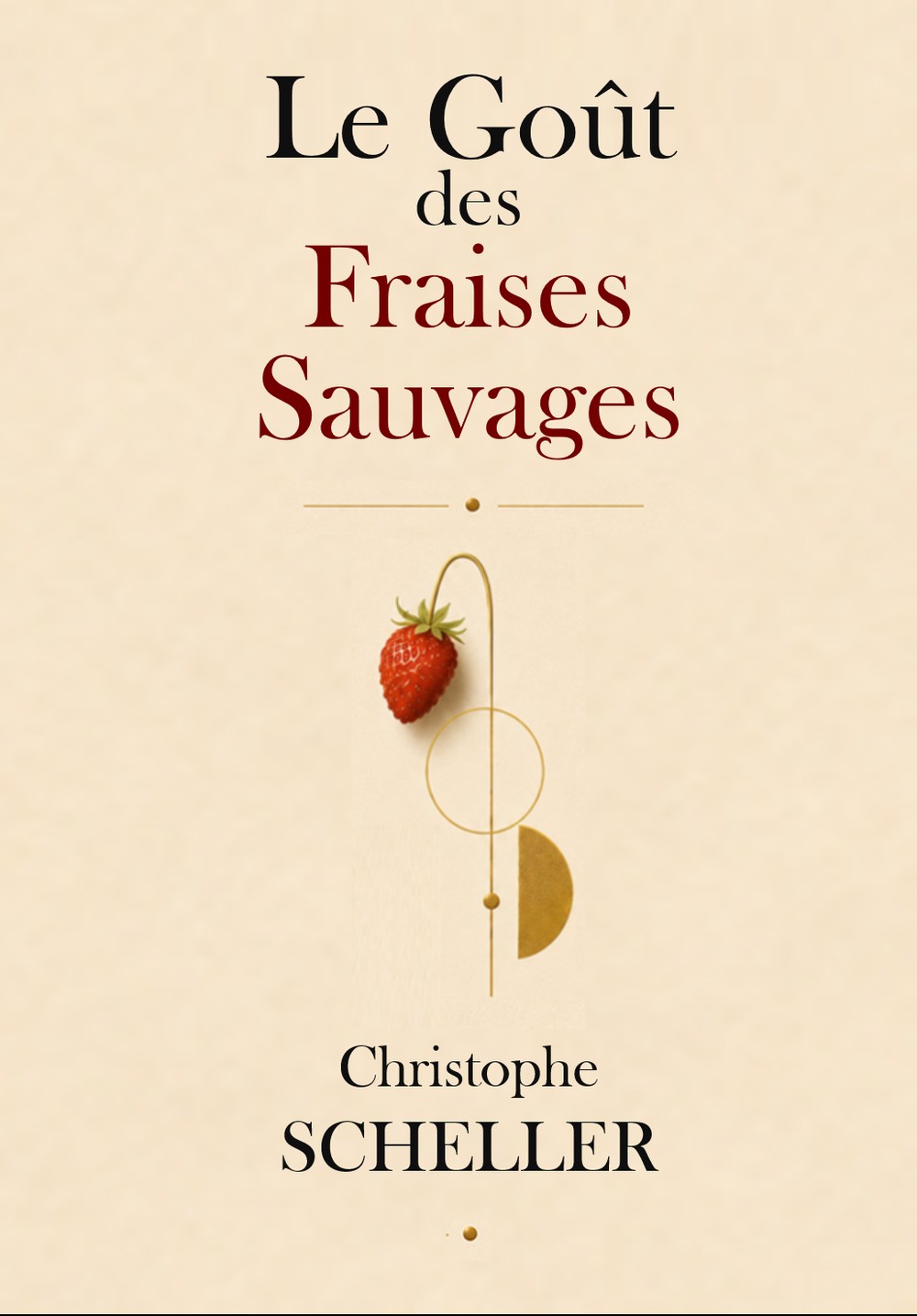
Cover of The Taste of Wild Strawberries by Christophe Scheller

A short note from the author

This encounter has been the greatest paradox of my life.

It went beyond anything I had imagined possible. It awakened feelings I had not known I could experience with such intensity. Through it, I discovered how deeply I could love, how much I wanted to give, to care for a woman and to build a life with her.

Then everything broke apart, suddenly.

The suffering struck me immediately. I was in pain. I suffered. I cried. The breakup deeply affected the man I was and the future I had begun to believe in. Yes, I resented her. Yes, I was angry.

With the same woman, in such a short time, I had experienced immense happiness and a pain I could never have imagined.

I could have fallen apart.

Yet that is not what happened. Through this ordeal, a new way of seeing the world opened up. A new energy emerged. I began to dare, to create, to undertake new things. Those close to me see a way of being that both surprises and reassures them.

Today, I hold together the beauty of this story and what it cost me. The pain does not make the happiness any less real. The tenderness of the memory does not erase the hurt.

The novel became the place where I could give each of them its full place: love, anger, longing and gratitude. Writing allowed me to hold them within a single story. This website carries forward my wish to share with you what this encounter continues to bring to life within me.

The story did not end as I would have wished. Yet what remains most precious to me is the tenderness of the encounter and of what we shared.

I suffered deeply from the separation. But this encounter now nourishes my desire to live.

Christophe Scheller

The novel

About the book

THE NOVEL

Can a story leave a profound mark on us when it barely had time to exist?

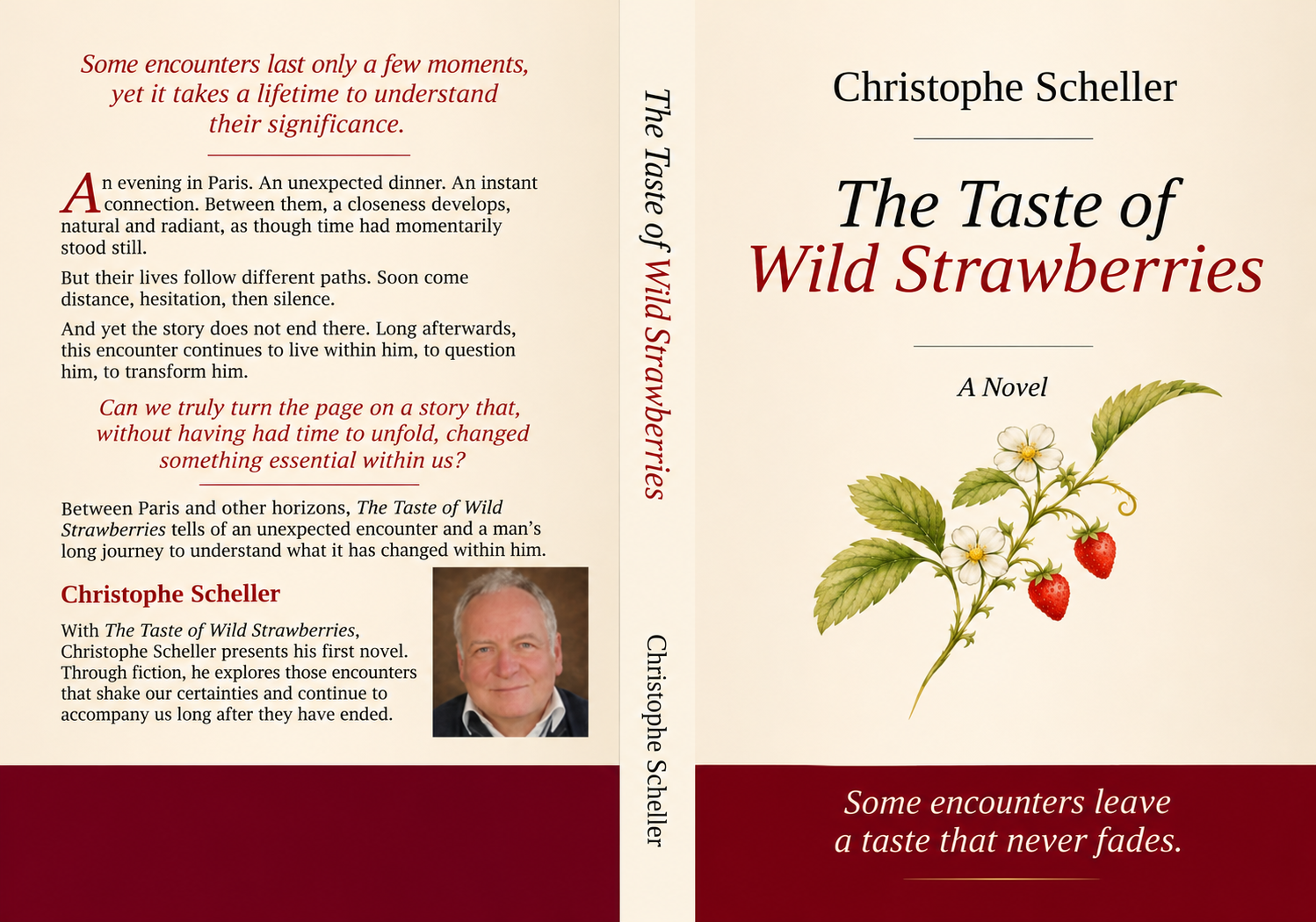
The chosen full cover: an ivory background, black and burgundy title, strawberry plant and burgundy band, with the author’s portrait on the back.
The book’s full cover, front and back

Christophe no longer expected to meet someone who could turn his life upside down.

Then came Juliana.

A few days in Paris. An unexpected sense of connection. And soon, the distance between Paris and Brasília, the silences, the waiting, and the strange impossibility of fully living a story that nevertheless refuses to fade.

Because some encounters never become a life together. They become part of us.

Le Goût des Fraises Sauvages tells the story of what remains when a relationship ends but what it awakened lives on.

Through memory, longing, desire, letting go and rebuilding, Christophe gradually tries to understand why some people pass through our lives for only a few moments yet leave a lasting mark.

An intimate novel about love, absence and those encounters that sometimes force us to see who we were — and who we might still become — in a different light.

Inspired by a true story, Le Goût des Fraises Sauvages explores the fragile boundary between what we actually lived, what we hoped to live, and what remains despite everything.

Discover the latest revisions to the novel →

Explore the novel’s project →

BEYOND THE LOVE STORY

When a Love Story Becomes a New Beginning

What if the most beautiful love stories are not necessarily the ones that last, but the ones that inspire us to live differently?

The Taste of Wild Strawberries tells the story of an impossible love. An intense encounter, a few days of happiness, followed by distance, absence, and the pain of a future that could never be lived.

But above all, this novel tells another story.

It tells how a single encounter can transform a life, awaken emotions we thought we had forgotten, and give rise to a new energy, even in the midst of suffering. How longing can gradually give way to self-discovery, to the desire to create, to share, to love again, and simply to the joy of feeling alive.

Not every love story is destined to become a life together. Some offer us something unexpected: a different way of seeing the world, other people, and ourselves.

This is not the story of a love that failed. It is the story of an encounter that succeeded in transforming a life.

PARIS — BRASÍLIA

There are stories that distance interrupts.
And others that it keeps from fading.

Read the novel

The complete novel is available as a PDF in French. I invite you to explore its pages at your own pace.

Read the novel in French (PDF)

The PDF opens in a new tab. English and Portuguese versions will be added when they become available.

The covers over time

Before we read its opening pages, we first encounter a book through its cover. The cover of Le Goût des Fraises Sauvages has evolved along with the text and my own perspective on this story. Here are the stages of that journey, ending with a new idea I am still considering.

Click a cover to enlarge it.

01 — In the beginning, a personal account

Understated first cover: cream background, title and a wild strawberry with golden ornaments.

Originally, this book was a biography. Its first cover reflected that intimate character with a very understated design: a pale background, a few golden accents and a wild strawberry. What mattered most was still in the words, in the need to tell the story and understand what I had lived through.

02 — The story becomes a novel

First novel cover: a couple seen from behind beside the Seine, facing the Eiffel Tower at sunset.

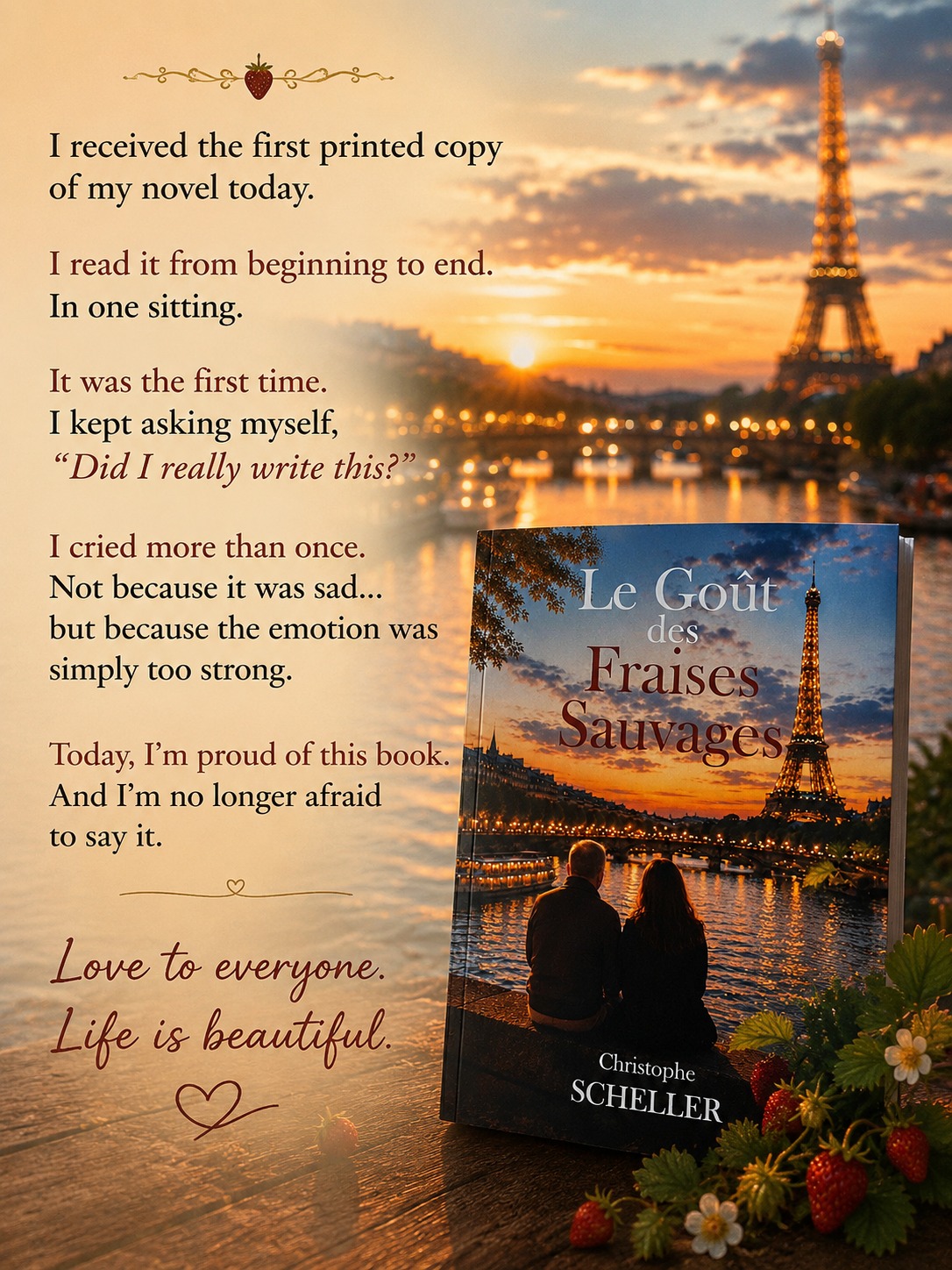
With the first version of the novel, the cover opens onto Paris. Two people, seen from behind, share a moment beside the Seine. The evening light, the Eiffel Tower and the wild strawberries set the scene for their encounter. The image now invites the reader to step into a story.

03 — Watercolour, closer to memory

Watercolour cover: a couple seen from behind beside the Seine, in pastel colours.

As the novel grew in depth, watercolour emerged as the natural choice. It preserves the scene while softening its outlines, as memory sometimes does. Its colours and lightness feel closer to what I wanted to convey: the tenderness of an encounter, its fragility and the trace it leaves within us.

04 — An idea to explore: the kiss

Cover idea: a couple kissing in a Parisian street, surrounded by touches of watercolour.

This new cover concept is still an idea I am considering. It evokes Robert Doisneau’s Le Baiser de l’Hôtel de Ville, reimagined through this encounter. After the figures seen from behind, faces appear and the kiss becomes the heart of the image. A more direct way of expressing the tenderness and romantic impulse that run through the novel.

Of all the covers I have imagined, this one is by far my favourite. But I will not use it without Juliana’s consent. And out of respect for her, I would not presume to ask her for it. So it will remain a possibility, an image I hold dear.

05 — The chosen cover

The chosen full cover: an ivory background, black and burgundy title, strawberry plant and burgundy band, with the author’s portrait on the back.

And in the end, I returned to my first loves. This is the cover I have chosen for the novel.

Read a few excerpts

READ A FEW PAGES

Four excerpts to step into the novel

The first glance

Act I — The encounter

A glance, a smile, then the desire to speak to this stranger.

Then Christophe looked up.

He saw her.

Her light brown hair, touched with lighter strands, fell freely over her shoulders. Soft features, dark and expressive eyes. She was beautiful.

But it was not really her beauty that held his gaze.

She was not trying to attract attention. Yet Christophe had immediately been drawn to her presence, to that utterly natural way she had of being there, without ever trying to impose herself.

And then there was her smile. A broad, spontaneous smile that seemed to spread across her whole face, all the way to her eyes.

She talked with her friend, sometimes accompanying her words with a gesture. Then she listened. Laughed. Became attentive again.

She seemed unaware that anyone might be watching her. And yet Christophe could not help looking at her.

He looked away, almost embarrassed by this sudden attraction, and tried to pick up the thread of the conversation. Above all, he did not want her to notice his persistent gaze, still less to feel bothered by it.

But a few seconds later, his eyes returned to her. Despite himself. He simply wanted to look at her again, to find that smile, that presence that had immediately touched him.

Hassan was still talking about the breakup he could not understand. Christophe was listening. At least he was trying to.

His gaze kept returning to her.

There was something deeply alive about this woman. A way of being wholly there, in a conversation, in a laugh, in the moment.

He knew nothing about her. Not her name. Not her age. Not the city she lived in. Not even the language she spoke.

He knew nothing of the life behind that smile.

For now, all he saw was a woman sitting a few tables away. And a smile that, for a reason he did not yet understand, kept him from looking entirely elsewhere.

One thing finally became clear to him.

He did not want to leave this restaurant without having spoken to her.

He leaned towards the table, moving closer to Juliana until he was facing her. Without a plan. Without really knowing what he was going to say.

She looked up at him.

For the first time, their eyes truly met.

Up close, Christophe found again the smile that had so drawn him in. He also discovered her eyes, bright, curious, almost amused to see this stranger come over to speak to her.

He hesitated for a second.

– Excuse me… May I take your photograph?

Juliana looked surprised. There was clearly something unexpected about the request.

Then she smiled again.

– Of course.

Christophe took the photograph. He could have thanked her and left it at that. But he had no desire to.

He took the opportunity to keep the conversation going. A few words led to others.

He learned that she was Brazilian, that she came from Brasília and that she was in Paris for a training course with the firefighters. She told him about her work, her stay, this city she was discovering with such enthusiasm.

She was leaving in three days.

Three days.

Christophe looked at her friend, then back at Juliana.

– And where is your husband?

Before Juliana even had time to answer, her friend burst out laughing.

– But she’s single!

Juliana rolled her eyes with a smile, caught between amusement and embarrassment. Christophe laughed too.

– Well… so am I.

This time, they looked at each other for a few seconds longer.

Nothing spectacular. Just a smile exchanged between two strangers in a Parisian restaurant.

Christophe asked for her number so he could send her the photograph. She gave it to him.

Everything had been astonishingly simple. No strategy. No calculated seduction.

Continue reading on Amazon →

A future that already seems to exist

Act II — Building a relationship

Between Paris and Brasília, everyday exchanges begin to sketch a future.

Then the conversation resumed. Effortlessly. Without either of them trying to keep it going. It seemed to move forward on its own.

Christophe sent her a few photographs of his Sunday. His lunch. The cake he had made. Then the Arc de Triomphe in the snow.

He simply wrote:

“You missed this.”

Juliana laughed. In turn, she showed him Brasília’s television tower. They joked about their funny Brazilian Eiffel Tower.

She promised to take him there for dinner when he came to Brazil. He was already imagining everything he would show her when she returned to Paris.

The most surprising thing was not that they were talking about the future. It was how naturally that future already seemed to exist.

They spoke like two people who already knew they would live it together.

Continue reading on Amazon →

The questions an encounter leaves behind

Prologue

Time and memory sometimes change the meaning of a story.

There are stories we live through without truly understanding them, whose meaning is revealed only much later.

Some seem to end one evening, at a station, an airport, or in a final message. Yet sometimes they go on living long after they have ended.

They shift slowly in memory. Return without warning. Change their face with time. Until one day, a question we thought we had put to rest presents itself differently.

Christophe and Juliana’s story belongs to that category.

When they met in Paris, nothing seemed likely to bring them together.

They lived on two continents. Two lives already built. Two lives filled with work, responsibilities and the fragile balances that age eventually imposes.

Chance gave them only a few days in the same city. A few days that might have been no more than a brief interlude among so many others.

They were not.

For a long time, Christophe believed this story had already revealed its meaning to him. He thought he knew where it had begun. Why it had ended. What it had left behind.

He was wrong.

Some truths emerge only once silence has returned.

It sometimes takes a long time to understand what a few weeks have truly changed. And longer still to discover that the questions we were asking may not have been the right ones.

That is where this story begins.

Continue reading on Amazon →

What if Juliana came back?

Act VII — Maturity

Some questions do not seek to predict the future. They help us see what has changed within us.

What if Juliana came back?

For a long time, the answer would have seemed obvious to him.

He would have gone back to her without hesitation.

He would have returned to the path he had never truly left in his heart.

Back then, only one thing mattered.

Loving her.

Today, though, the answer no longer seemed so simple.

Not because he no longer loved her.

Love had never been the question.

But Christophe had come to understand that his love for Juliana had not been nourished only by the woman she was.

It had also been nourished by the love he had believed he received from her.

By her words. By the place she made for him in her life. By the way she had believed in them.

He had loved Juliana. And he had deeply loved being loved by her.

That certainty had nourished his own love far more than he had understood at the time.

It had given their story a sense of inevitability.

It had turned an extraordinary encounter into a possible future.

And something had broken there too.

Something Christophe had taken a long time to accept.

The wound.

For months, he had searched for the reason their story had ended.

He had tried to understand Juliana.

Her fears. Her contradictions. The choices she might have faced.

He had learned to accept that a story could be profoundly true and yet find no place in a life.

But understanding that did not erase what had happened.

Then he imagined what that return might look like.

Not necessarily in Paris. Not at his door.

Simply in his life.

If one day her name appeared on his phone again.

If, behind that name, he heard again the voice he knew by heart.

And if she simply said to him:

“Chris... I still love you. I know you're the one.”

For a few seconds, everything he thought he had understood fell away.

The analyses. The hypotheses. The answers patiently pieced together.

Only one feeling remained.

Immediate.

Almost untouched.

The heart has its own memory.

Sometimes it recognises someone before thought has even begun its work.

Christophe knew that.

Something within him would recognise Juliana.

Her smile. Her voice. That tenderness he had loved so much.

Perhaps even that light he had thought he saw again whenever she appeared on his screen.

And for a few seconds, perhaps he would simply want to take her in his arms.

But he now knew that another memory would awaken almost at once.

The memory of February 4.

And with it, a question that had never existed before.

Could he still believe in her love in the same way?

Not because he would think Juliana was lying.

Perhaps that was precisely what made the question so difficult.

She could already have loved him sincerely.

She could already have sincerely believed in their future.

And yet she had left.

Christophe had come to understand that love and the possibility of living that love were not always the same thing.

That understanding had helped him see their story differently.

It had even allowed him to imagine that Juliana’s decision might not have been a rejection of him. That perhaps she had simply been unable to choose the life they would have needed to build to live that love.

But that same understanding also changed what a possible return would mean.

Once, hearing I love you would have been enough.

Today, Christophe could still believe her.

But believing her would no longer be enough.

Continue reading on Amazon →

The novel’s latest revisions

THROUGH THE REWRITING

The latest revisions to the novel

Since the originally published version, I have extensively reworked Le Goût des Fraises Sauvages. I wanted to bring the story more fully to life and explore Christophe’s experience in greater depth, while leaving more room for contradictions and unanswered questions.

I began by developing the characters and scenes. We learn more about Christophe’s life before the encounter, his habits and his sense of balance. Juliana and Karima also become more vivid through their gestures, expressions and ways of being. My aim was to help readers get to know them better and feel what draws Christophe to each of them.

Above all, I expanded the development of his relationship with Juliana: their everyday exchanges, the place they make for each other in their lives, their families, learning French, travel preparations and plans for the future. I wanted to show more clearly why Christophe had believed in this story, and how both of them had made it real despite the distance.

This led me to explore the breakup and its consequences more deeply. The pain is more tangible: the difficult nights, the tears, the cancelled trip, the future he no longer knows how to replace. I also allowed his anger, disappointment and difficulty understanding the silence to emerge. I wanted his journey towards peace to make real room for the wound.

The story with Karima has also been reworked. Christophe’s indecision is more apparent: unable to choose between two possible lives, he eventually lets her leave without trying to hold her back. This passage gives greater weight to his own responsibility and sheds a different light on how he sees Juliana: he too knows how difficult it is to give up one life in order to choose another.

Finally, I revised the ending to make Christophe more cautious in his interpretations. He considers several reasons for Juliana’s departure, but accepts that he may never know what really happened within her. His peace no longer depends so much on an explanation he needs to believe.

I also wanted to show that moving forward could mean rediscovering the pleasure of living, of looking at someone, of loving again one day, while preserving the trace of that encounter. And if Juliana were to return, feelings would no longer be enough: trust, too, would need to be rebuilt.

Through these changes, I have tried to preserve all the beauty of the story while fully acknowledging what it cost Christophe. The new version expresses this conviction more strongly: a story can have been deeply sincere without managing to become a shared life. And we can retain its value without having to soften its ending.

A novel that keeps growing

Le Goût des Fraises Sauvages — A novel that keeps growing

From version 74 to version 87

When I began writing Le Goût des Fraises Sauvages, what I wanted above all was to tell the story of an encounter. A true, beautiful, improbable story that had deeply marked my life, and whose meaning I needed to understand.

At the time, I thought all I would need to do was revisit my memories, recount the events, put emotions into words and, perhaps, find a little peace through writing.

I never imagined this book would come to occupy such a place in my life.

Today, this novel has become something of a baby to me.

I watch it grow, evolve and change. I grow more attached to it every day. And I must admit that bringing it to life has become a real passion.

Every rereading makes me want to go a little further. A scene seems to deserve more depth. A character could be better understood. An emotion could be expressed more accurately. Sometimes, just a few words are enough to give a passage a whole new dimension.

Between versions 74 and 87, this is precisely the work I wanted to continue.

Bringing the characters more fully to life

One of my main aims was to make the characters more alive, more present, more fully realised.

I did not want them to be merely the protagonists of a love story. I wanted them to feel real to readers.

I wanted readers to be able to imagine their glances, their smiles, their hesitations. To accompany them through their conversations, their moments of happiness, their doubts. To understand better what brings them together, but also what can pull them apart.

So I revisited many scenes, particularly those of their meeting in Paris, their first moments together, their exchanges and the closeness that developed almost naturally.

I tried to give more space to small gestures, to everyday details, to those seemingly unremarkable moments that, in hindsight, take on immense importance.

Because a story is not simply the sum of its events. It also lives in everything that happens between them.

Have I succeeded in bringing my characters more fully to life? I do not know. That will be for readers to judge. But it was certainly the ambition I had set myself.

Sharing more of myself, and showing who I am

This new version also marks an important development: I chose to say much more about myself.

After all, Le Goût des Fraises Sauvages tells a story that is also my own.

In the early versions, I had focused mainly on recounting what had happened between Juliana and Christophe. But as the novel progressed, one thing became clear: to understand what this encounter had meant, readers also needed to know more about the man who had lived through it.

So I gave more space to my personal history, my daily life, my work, my son, my friends, squash, travel and those small pleasures that make life happy.

I wanted to show the man I am, with his convictions, his values, his qualities, but also his contradictions and imperfections.

My attachment to freedom, to respect for others, to intellectual honesty. My preference for sincere relationships. My way of looking for solutions, of believing that compromises are possible, without agreeing to give up what seems essential to me.

And above all, I wanted to make one thing clear: I was not an unhappy man waiting for an encounter to fill a void in his life.

I was happy. I still am.

Juliana did not come into my life to fix something. She simply awakened a new desire: to share with her a life I already loved.

That distinction mattered deeply to me.

I wanted readers to discover Christophe as he really is. Through him, I wanted them to be able to get to know me, beyond this love story alone.

Understanding without claiming to explain everything

Another important part of the work concerned how to tell the ending of this story.

Over time, my perspective changed.

I came to understand that I could try to make sense of the difficulties, the circumstances and the differences between our two lives, without claiming to know what Juliana had truly thought or felt.

I wanted that distinction to be more present in the novel.

To tell what I had lived through, what I had hoped for, what I had understood. But also to acknowledge what still eludes me.

It was no longer about seeking an explanation at any cost, still less about finding someone to blame.

It was about looking at this story with greater distance, respect and, I hope, accuracy.

A story that lives on

Between version 74 and version 87, the novel has therefore changed considerably. It has been enriched with scenes, memories and reflections, but also with a deeper understanding of its characters.

I also reworked its rhythm, its transitions, its dialogue and its silences, so that the reading would flow more naturally and the emotions would find their proper place.

I do not know whether I achieved everything I had hoped for.

But I know this work has absorbed me completely.

At times, it led me to revisit happy memories; at others, more painful moments. It also prompted me to reflect on my own convictions, on the way I love and on what I want to preserve in my life.

This novel was born of the need to give an extraordinary encounter a place of its own.

Over successive versions, it has become something even more personal: a way of sharing not only a story, but also a part of who I am.

And if I keep developing it, it is not because I am desperately searching for a perfect version.

It is simply because I love this book.

Because it has become my baby.

And because, when you love something, you naturally want to see it grow, flourish and become as beautiful as it can be.

I do not know whether this novel will touch many readers. But if, when they close its pages, a few feel they have truly met Christophe and Juliana, then I will have achieved one of my most cherished aims.
The literary project

The book’s intention, its story and a reflection on its writing: a dossier by Christophe Scheller exploring the literary project.

Why I wrote this book

FROM THE WORLD OF PROJECTS TO WRITING

A book I had never thought of writing…
but that it had become impossible not to write.

For thirty years, I worked in a world where we can usually understand problems, analyse constraints and look for solutions.

Then I encountered something that could not be solved.

How can someone continue to transform your life when they are no longer part of it?

I had never imagined writing a book. I am an engineer. I spent most of my professional life analysing, managing projects, making decisions and seeking solutions.

And then there was an encounter. One that, long after it ended, kept asking me a question no method could answer.

So I began to write.

Not to publish.
Not even to tell a story.
To understand.

Little by little, memories became pages. Pages became a story. And the story became a novel.

A novel about love, memory, absence and those encounters that do not necessarily become a shared life… but can become part of us.

I do not know what you will find in this book. Perhaps a love story. Perhaps a reflection on memory and what we do with our memories. Or perhaps simply something that reminds you of someone.

Because we have probably all, at some point, met someone who changed something within us.

Today, I am happy finally to share this book with those who have known me for a long time — sometimes for several decades — but who may discover here a side of me they know less well.

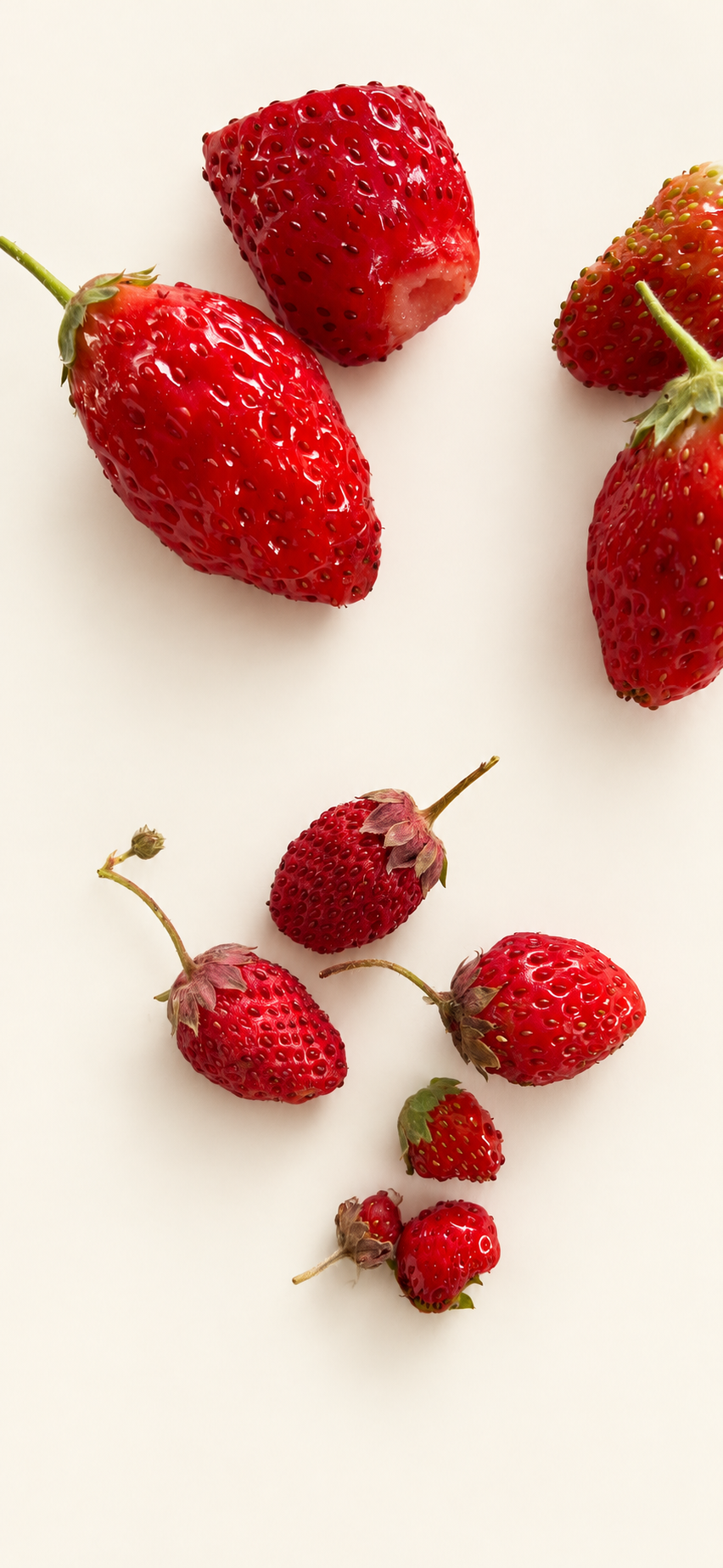
Strawberries, including small wild strawberries.
Find me on LinkedIn Discover the book

The synopsis

This dossier reveals important plot details, including the ending. To discover the novel without spoilers, start with the excerpts.

Read the excerpts →

In Le Goût des Fraises Sauvages, I tell the story of a mutual love that opens up the possibility of a shared life, and then of how its ending continues to transform the person left behind. Memory, writing and the reconsideration of an earlier relationship accompany this journey. But understanding differently means neither knowing the other person’s whole truth nor erasing the wound.

Christophe leads a balanced life in Paris, rebuilt after his divorce, between his work as an engineer, his son, his friends and squash. At a dinner with his former wife’s new husband, himself facing a separation, he notices Juliana, a Brazilian military firefighter visiting France for a training placement. Her smile prompts him to speak to her. Only a few days remain before her return to Brasília. They exchange messages, decide to spend an evening together, then part at the airport after a kiss that gives their encounter an unexpected depth.

Distance does not bring this interlude to a close. For almost three months, their messages, calls and photographs build a daily presence. They tell each other about their work, their families, their worries and the small events of their days. Christophe discovers Juliana’s faith, her tenderness, her courage and the central place of her daughter Esther. Juliana confides her vulnerabilities to him, tells him she feels safe with him and takes an active part in their future. Their love also draws strength from this shared experience: loving and knowing oneself to be loved.

Meeting again becomes a concrete plan. Christophe books his ticket for February. Juliana prepares to welcome him, arranges her apartment, learns French and imagines the places they will discover together. They discuss other trips, the possibility of marriage and a family. Without yet having shared everyday life under the same roof, they begin to inhabit a shared life inwardly. The narrative even shows Christophe arriving in Brasília, the embrace in the arrivals hall and the apartment door opening. Then his awakening reveals that the scene was a dream: the trip has not yet happened.

On February 4, a few days before the planned departure, Juliana tells him they cannot be a couple. For Christophe, nothing in their recent exchanges had prepared him for such a sudden ending. The woman who was still arranging his visit seems to have become the one excluding him from that future. He understands the words of the message but cannot connect this decision to the story they were building together. The breakup destroys a plan, a certainty of being chosen and the coherence of his inner world all at once.

Yet they continue for a while to take care of each other. Juliana considers welcoming him as a friend; Christophe tries to believe they could preserve their encounter in that way. Both eventually recognise that, after what they have experienced, this friendship cannot give the trip a bearable form. Christophe cancels it. The imagined future disappears, while sleepless nights, tears and everyday reflexes make its absence felt. Messages grow less frequent. A few gestures of affection remain, notably on his birthday, before silence occupies an ever greater place.

Christophe rereads their conversations. He tries to understand how Juliana could see him as the man of her life while doubting the life they could actually build. The need for a presence beside her and Esther, responsibilities and distance become more visible to him. He begins to see that sincere love may fail to become a life choice. Yet this understanding remains incomplete: it does not explain with certainty what happened between the day before and the day of the breakup.

He begins writing to preserve the traces of their story. Gradually, the narrative allows him to move through it differently and to examine his own way of loving: his tendency to give possibilities the substance of memories. He sends his manuscript to Juliana. In the novel, her reply brings another voice. She affirms the reality of her love, says she felt seen and describes the loneliness that returned after their conversations. Her perspective shifts Christophe’s without offering an exhaustive explanation of the separation or of the silence that follows.

An earlier confidence from Juliana about a relationship preceding their encounter then awakens the memory of Karima. Many years before, Christophe had loved this woman while another future was already taking shape in his life. Unable to bring his feelings and his choices into alignment, he had let her go. This memory places him on the other shore of separation. He discovers what it can cost to give up a love that is still alive and considers what his own silence may have left with the other person. The two stories illuminate each other, but Karima’s never becomes proof of what Juliana might have experienced.

Christophe considers several hypotheses: the weight of distance, fear of stepping into reality, another relationship, or the inability to choose the life they imagined. None is his to claim as a certainty. He also learns not to reduce Juliana to a single face. The loving woman who made room for him and the woman whose decision and subsequent silence wounded him are the same woman. Acknowledging the beauty of their love no longer obliges him to soften the violence of its ending.

Life begins to draw his gaze again. One evening, after laughing with friends and enjoying a smile exchanged with a stranger, Christophe wonders what he would do if Juliana returned. The feeling could be rekindled; trust would not return through the force of a declaration alone. Asked whether he could entrust his heart to her again, his present answer is no. But that no does not determine what he would do in a real encounter. Time, explanations and the possibility of looking together at what was broken would be needed. Christophe closes the hypothesis: he no longer has to answer today on behalf of the man he would be then.

The epilogue leaves longing, disappointment and occasional anger at the silence intact. Yet Christophe can lay this story down in the book without making it false or asking Juliana to be different from who she was. The memory of the wild strawberries of his childhood gives this lasting trace an image: a rare flavour that lingers without being reproducible. The encounter mattered. It does not need to have lasted to have been true, nor to be fully explained to find a place in his life.

Reflections on the writing

Style: language and formal choices

I sought a simple language, close to the gestures and words through which a relationship is built. Dinner, a shared dessert, a box of macarons or photographs sent during the day give love a concrete presence. I wanted readers to understand why this encounter matters before the character begins analysing its consequences.

Short sentences and numerous isolated paragraphs are a highly visible formal choice. They slow certain moments, draw out a word and make perceptible the work of a thought advancing through successive returns. In the breakup scene, this fragmentation accompanies shock. The message arrives in pieces; Christophe rereads it because his understanding of the words has not yet caught up with what is happening to him. The rhythm is therefore not simply slow. It can establish tenderness, suspend an expectation or convey an abrupt upheaval.

Exchanges in French, English and Portuguese are also part of this novelistic language. I preserve their simplicity and sometimes their awkwardness because these contribute to intimacy. The words do not circulate between abstract voices: they seek a common language. “Saudades”, terms of endearment and learning French show how two people try to bring their worlds closer. The telephone thus becomes a narrative space, first inhabited by presence, then marked by notifications that no longer arrive.

Repetition accompanies shifts in meaning. The airport, the apartment door, morning coffee and the same phrases from Juliana return in different lights. The anticipated scene in Brasília becomes a dream, then the trace of a lost future. Words that once reassured can later awaken pain or support another interpretation. Rather than repeating an emotion, I seek to show how memory revisits the same elements without making exactly the same story of them.

However, I can no longer describe this writing as entirely free of commentary or psychological analysis. The narrative contains long passages of reflection, explicit questions and statements of general scope. As Christophe writes, his thought becomes a central substance of the novel. Formulation, contrast and questioning do more than connect scenes: they give them direction. This choice allows us to follow his inner shift precisely, but demands vigilance about the space left to readers.

The recurring use of “perhaps”, “for a long time” and certain contrasting constructions serves a purpose: it makes hesitation, duration and the revision of certainties felt. Their accumulation also carries a risk of monotony or insistence. Likewise, isolated sentences can give every proposition comparable weight when they do not all have the same importance. My standard is to maintain a distinction between a return that transforms meaning and one that merely restates what has already been understood.

The third person allows me to transform personal material into narrative. It does not remove emotional proximity to Christophe, but avoids entirely conflating his voice with mine. The distance remains fragile: the narrator often follows his reasoning and can express his conclusions forcefully. I therefore need to preserve the markers that locate those conclusions within a consciousness, especially when they concern Juliana.

Today I place this work on language at the meeting point of sensory narrative and meditation. Its purpose is to hold together the experience of love and that of the wound, without turning reflection into a demonstration that simplifies them. The restraint I seek lies as much in caution about certainties as in simple vocabulary.

Themes and values: literary, philosophical and symbolic concerns

I wanted to tell the story of a love in which two people truly took part. Juliana does not merely receive Christophe’s impulse: she proposes, prepares, reassures and imagines a life with him. This reciprocity is essential because it gives the breakup its depth. Christophe loses a woman he loves, but also the experience of feeling loved and chosen by her.

The novel gradually distinguishes feeling, the choice of a life and the trust needed to inhabit it together. These dimensions can come together without being equivalent. Loving does not guarantee that one can rearrange family or professional life. Believing in a future does not yet mean being able to choose it. And believing in the other person’s sincerity is not always enough to feel safe with them again after a breakup.

I do not want to turn this distinction into a certain explanation for Juliana’s departure. It offers Christophe a possible understanding. Distance, loneliness, responsibilities, another relationship or fear of what the trip would make real belong to his exploration. The narrative does not give him the power to decide which of these hypotheses contains the whole truth. Accepting that limit is part of his transformation.

The wound also lies in how the separation is experienced. They built the future together; Christophe receives its ending as a decision already made without him. His anger and the feeling of sometimes having been used are realities of his experience. I let them exist without turning them into a verdict on Juliana. The word “used” says something about Christophe’s pain; it does not demonstrate an intention to manipulate.

This distinction involves a value I hold dear: recognising the other person’s freedom without making one’s own suffering illegitimate. Juliana has the right to choose her life and set a boundary. Christophe can accept that right while remaining wounded by the abrupt upheaval and the silence. His conception of love includes a responsibility towards the trust that has been placed in it. The novel explores this demand from his position without turning it into a right to determine Juliana’s future.

Silence changes meaning throughout the narrative. It can be intimacy without words, a slowing of exchanges, then a distance experienced as erasure. In Karima’s story, it also carries Christophe’s inability to choose and to speak. I do not assign it a single meaning. Even when he imagines that Juliana’s silence might protect the life she has chosen, he acknowledges that he does not know. That possibility removes neither his disappointment nor his anger.

Juliana’s two faces then become a major concern. Christophe can no longer preserve only the luminous woman of the first months, but neither does he want to reduce her to the woman who wounded him. He learns to make room for a person who remains partly contradictory to him. The beauty of the story and the violence of its ending can be acknowledged together. In this coexistence, I see a form of truthfulness more demanding than either idealisation or condemnation.

Memory does not look only towards the past. Christophe also mourns a future: places, habits and a family that had already found a place within him. The dreamed scene in Brasília gives substance to this “memory of the future”. He loses a world he never lived in, but whose absence genuinely affects his present. This tendency reveals both his capacity for wholehearted hope and his vulnerability.

Karima allows him to recognise that he himself loved without managing to choose the life that love opened up. This reconsideration does not establish a moral equivalence between two stories. It shifts his position and leads him to examine what his silence may have cost. It also reminds him that a bond can change its language, as their later meeting with their children shows, without becoming the obligatory model for what should remain with Juliana.

The scene “What if Juliana came back?” extends this reflection through a new boundary. His heart could recognise the woman he loved; life could not simply resume where it broke off. The no expresses his present inability to entrust his heart to her again with the same sense of safety. Yet it leaves open the question of what might one day be rebuilt. Above all, I wanted Christophe to stop writing an answer for a future that does not exist.

Finally, writing and the title give form to what remains. The wild strawberries come from an explicitly narrated childhood memory: small, rare fruits whose flavour persists. This image does not transform suffering into a necessary benefit. Christophe’s gratitude is directed towards the encounter, never towards the separation. The book can hold what it revealed without claiming that every wound has disappeared.

Intertextuality: affinities, references and literary traditions

I did not conceive Le Goût des Fraises Sauvages as an extension of a particular work. The affinities I can recognise concern above all a way of making time, memory and inner life into the substance of a novel. I prefer to present them as affinities of approach rather than claim influences the text would not allow me to establish.

Memory acts less as an archive to be restored than as an activity. A preserved sentence, a photograph or a gesture takes on new meaning when reread from another moment in life. The taste of wild strawberries connects a childhood sensation with this persistence of experience. The title thus finds its grounding in the novel itself, without needing to make it proof of a tribute to another work.

I also recognise myself in a tradition of love stories attentive to the difference between the intensity of an encounter and its possibility of lasting. The narrative draws on familiar situations: an unexpected meeting, departure, letters or messages, anticipated reunion. But the journey never takes place. Waiting becomes an experience to be told in its own right, and the character’s development gradually takes the place of the romantic resolution.

The messages introduce a contemporary epistolary dimension. They build intimacy, give plans an everyday reality, then become the traces Christophe questions. Juliana’s response to the manuscript opens up a space of speech different from his. This voice exists within the novel’s construction; I do not present it as an external document guaranteeing the biographical truth of the narrative. It conveys a perspective without abolishing all opacity.

Finally, the novel engages in reflection on narrative itself. Christophe begins by preserving a story and discovers that telling it transforms the person who remembers. This dimension brings the book close to a literature in which personal experience becomes a question of form and knowledge. Yet it is not about escaping lived experience through a theory of fiction: lost sleep, gestures without a recipient and anger remain the concrete ground of this reflection.

Karima’s story is above all an echo within the book. Two experiences distant in time answer each other and alter their respective meanings. This dialogue belongs to the novel’s construction rather than to an external reference. It allows an exploration of the two shores of separation while reminding us that similarities between situations never suffice to know the other person’s life.

I thus place my work in a literature of intimacy that accepts thinking explicitly about experience without claiming to resolve it. Its ambition is to offer readers situations, voices and questions to which their own memory can respond. The book’s reach depends on this possible encounter more than on its connection to a school or an author’s name.

Narratology: narrative voice, time and the construction of meaning

I chose a narrator outside the story, in the third person, with a focalisation mainly attached to Christophe. Readers follow his perceptions, emotions and shifts in interpretation. This proximity is decisive during the breakup: the narrative conveys what he cannot reconcile rather than immediately presenting an explanation from above the characters.

Yet the narrator is not simply a silent observer. He comments, offers general propositions and accompanies the character’s thought at length. Some sentences approach his inner voice; others broaden his experience. This presence gives the novel its meditative dimension. It also requires distinguishing what is experienced, what is asserted by a character and what remains a hypothesis about the other person.

Juliana exists first through what Christophe sees of her, their exchanges and their shared scenes. Her message after reading the manuscript introduces a more extended opportunity to speak. This change does not establish omniscience: someone recounting their experience does not necessarily tell everything about their life. Subsequent questions, particularly in the epilogue, maintain the gap between words received and complete knowledge of her reasons.

The progression is organised into four parts. “The birth of something undeniable” builds love between Paris and Brasília. “The turning point” conveys the breakup, the cancelled trip and the disappearance of the imagined future. “The man who remains” shifts the question towards the trace left within Christophe and towards writing. The fourth part, “The Taste of Wild Strawberries”, welcomes Juliana’s perspective, the memory of Karima and the final reconsiderations. The prologue announces that meaning will come after events; the epilogue shows what this understanding can still leave unresolved.

The chronology of the relationship provides an axis, but the novel does not rely on an entirely linear succession of events. Karima’s story is an extended return to an earlier relationship. Other memories, notably their later meeting with their children, are revisited according to the needs of present understanding. Certain scenes are therefore told when they become illuminating rather than in the place they would occupy in a biography.

The Brasília sequence plays a particular role. It is first narrated with the sensory precision of an event that has taken place. The awakening then forces readers to revise its status. This arrival is neither an actual reunion nor an announcement of an episode to come: it is the dreamed scene of a future in which Christophe already believes. The device lets readers experience the substance of that possibility before showing its loss.

This scene prepares a formal relationship with “What if Juliana came back?”. At first, imagination fulfils a life before it exists. Later, Christophe examines a possible return but refuses to go so far as to decide what follows. The final hypothesis therefore does not fill in the future: it measures what has changed in the present. The no concerning trust and the refusal to predict an actual response have different functions, which I want to preserve.

Narrative duration is distributed between closely observed scenes, summaries of weeks and long passages of reflection. The contrast between the three months of love and the time devoted to their aftermath indicates where the focus gradually lies. After the breakup, the narrative progresses through rereadings. The same messages become supports for a new thought; they do not supply an additional fact each time.

Karima’s story is not the missing piece of an investigation into Juliana. It transforms Christophe’s position: the person left behind recognises the man who could not choose and who let someone go. The comparison opens a human understanding while keeping the situations distinct. I do not want readers to take this mirroring as a demonstration of Juliana’s hidden motives.

Closure rests on a changed relationship with uncertainty. The character does not resolve every cause of the breakup, reunite with Juliana or promise restored trust. He can let the two faces of the woman he loved coexist and acknowledge his own wound. This ending seems consistent with the narrative construction: a consciousness can learn to live with what it does not know without the narrator artificially supplying the answer.

Finally, the construction requires leaving room for readers’ freedom despite the importance of commentary. Open questions alone are not enough to guarantee that freedom if every scene is followed by its interpretation. I therefore recognise the tension between the precision of Christophe’s journey and the risk of guiding readers too strongly. The plurality of hypotheses and the persistence of anger in the epilogue are essential if peace is not to become an imposed explanation.

Concluding the dossier

As I complete Le Goût des Fraises Sauvages, I better understand what I was trying to preserve: a whole story. A love in which two people believed, a future they began to imagine, a breakup experienced with profound violence and the silence that eventually distanced them. Christophe’s transformation does not require choosing only one of these realities.

Writing led me to distinguish more clearly what love allows us to feel, what a life can accommodate and what trust allows us to entrust to another. These questions touch but do not resolve one another. Understanding that Juliana may have loved sincerely is not enough to know her choices. Recognising her right to leave takes nothing away from Christophe’s wound. Imagining that a life might have been different does not allow us to say what it would have been.

The memory of Karima gives this work a depth Christophe could not find by questioning Juliana alone. He also encounters his own limits, his silences and the consequences of his inability to choose. This mirror opens his perspective without giving him authority over the other person’s. I want understanding to remain an approach, sometimes fruitful, never a possession of Juliana’s truth.

For me, the scene of a possible return marks an essential stage. Christophe knows that love would no longer be enough to make trust intact. He can name this limit without turning his present no into a final decision about an unknown situation. By closing the hypothesis, he stops inwardly living a future on behalf of those who would one day have to choose it. He accepts that certain answers cannot be written in advance.

The ending therefore removes neither longing nor anger. The silence can still seem cruel to him; the encounter can remain precious. I did not want gratitude to erase pain, nor pain to make their shared love retrospectively false. The book becomes the place where these two truths can remain together without imposing an explanation on Juliana that she has not given.

Fiction allows me to give form to this experience and offer it to readers without reducing the novel to a record of facts. It does not repair the life that never happened. It makes legible the journey of a man learning to recognise what he lived, what he imagined and what he may never know. On that condition, the flavour of wild strawberries can endure: as the trace of an encounter that mattered, whose meaning can still evolve without the future already being written.

The author and his world

About Christophe

Christophe Scheller, author

ABOUT THE AUTHOR

Christophe Scheller

Le Goût des Fraises Sauvages is Christophe’s first novel.

It grew out of an encounter that profoundly marked his life.

What was initially meant to be an account of a personal story became, through writing, a reflection on love, time, and the room our lives can — or cannot — make for our feelings.

How much of this story comes from lived experience? How much belongs to fiction?

Perhaps only those who recognise themselves in these pages know the answer.

The author has chosen not to answer that question.

It is for the reader to imagine where one ends and the other begins.

By the time he finished writing this first novel, Christophe had reached this conviction:

Facts belong to biography.
Truth belongs to the novel.
Discover why I wrote this book ↓

Things I love

WHAT THE AUTHOR LOVES

A few of the things I love

Travel. Paris. The ocean. Friends. Long conversations around a table. Places where we feel at home. And, for some time now, the pleasure of writing.

Friends and shared moments Travel and the ocean Paris and its terraces The pleasures of the table Writing and Le Goût des Fraises Sauvages
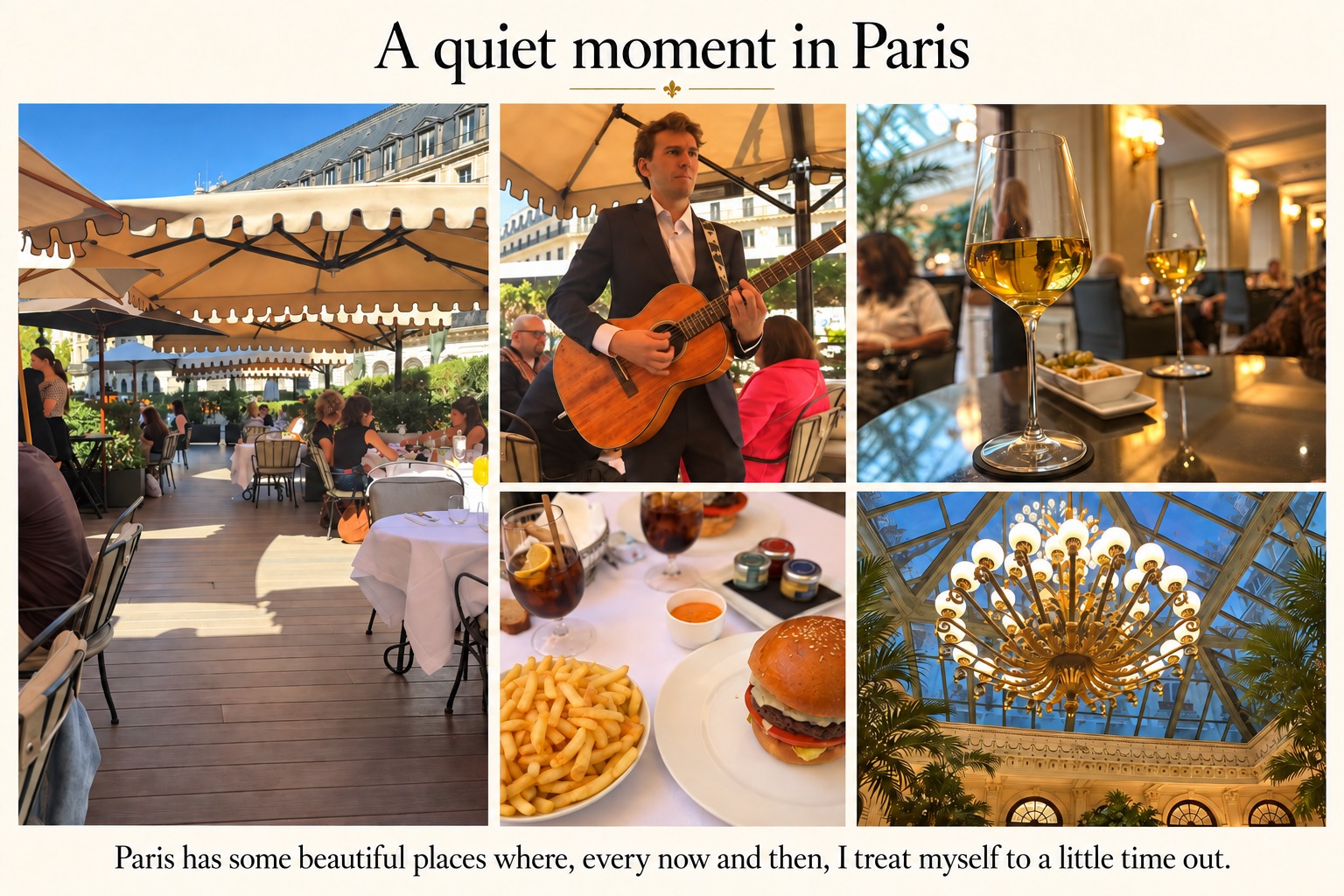
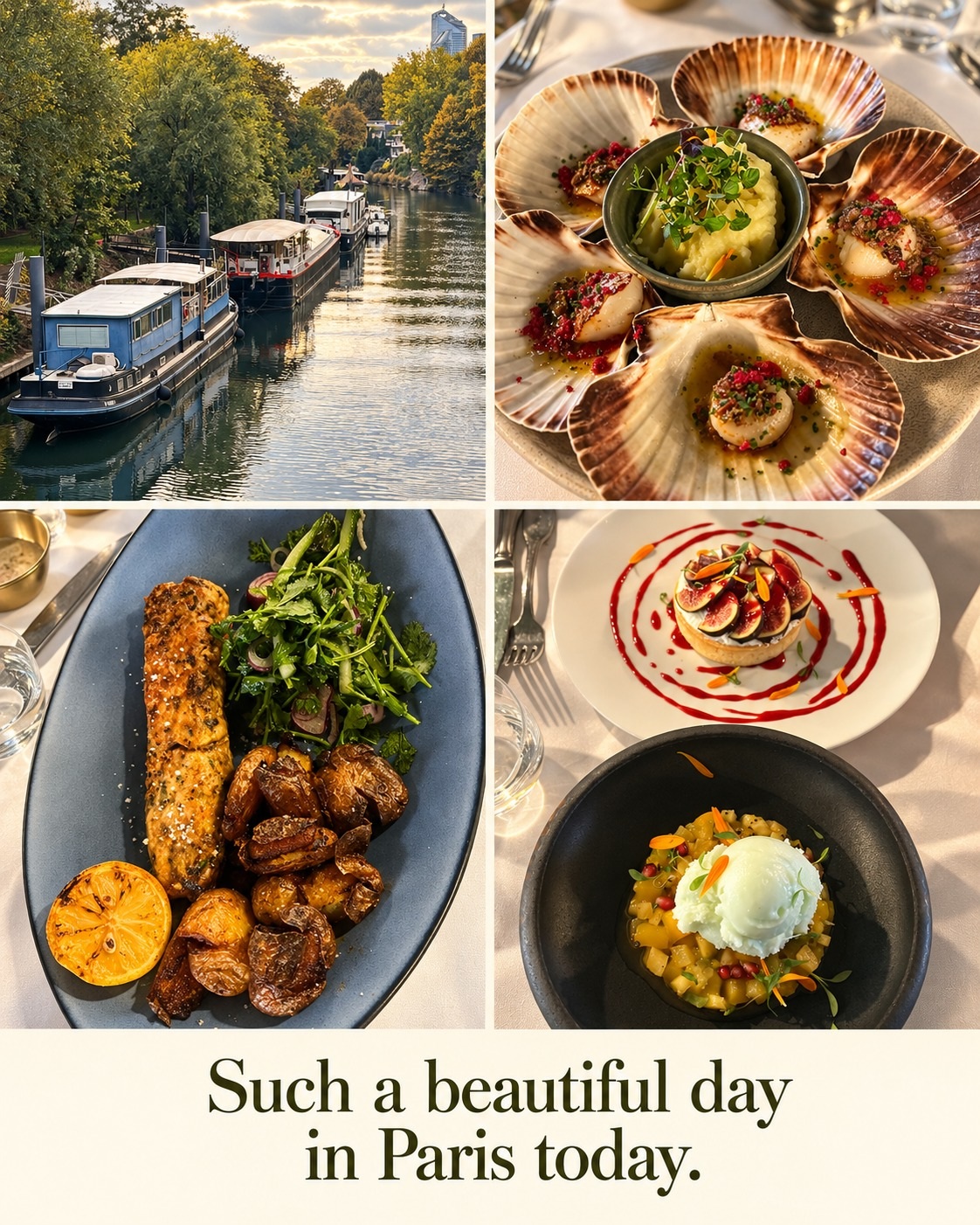
A collage of a waterside walk in Paris and dishes enjoyed at a restaurant.
Paris and the pleasures of good food
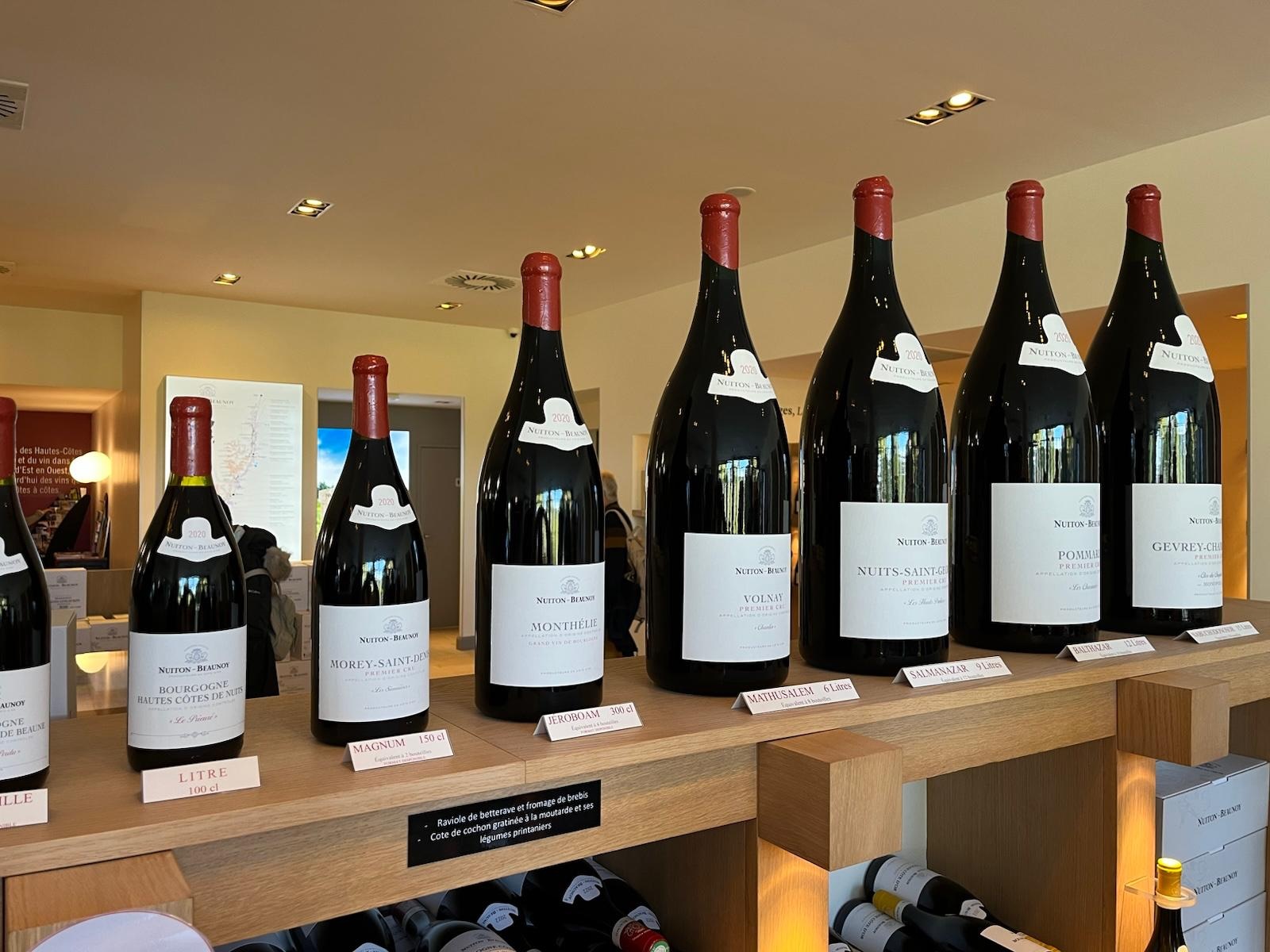
A collection of Burgundy wine bottles in various sizes.
Discovering Burgundy wines
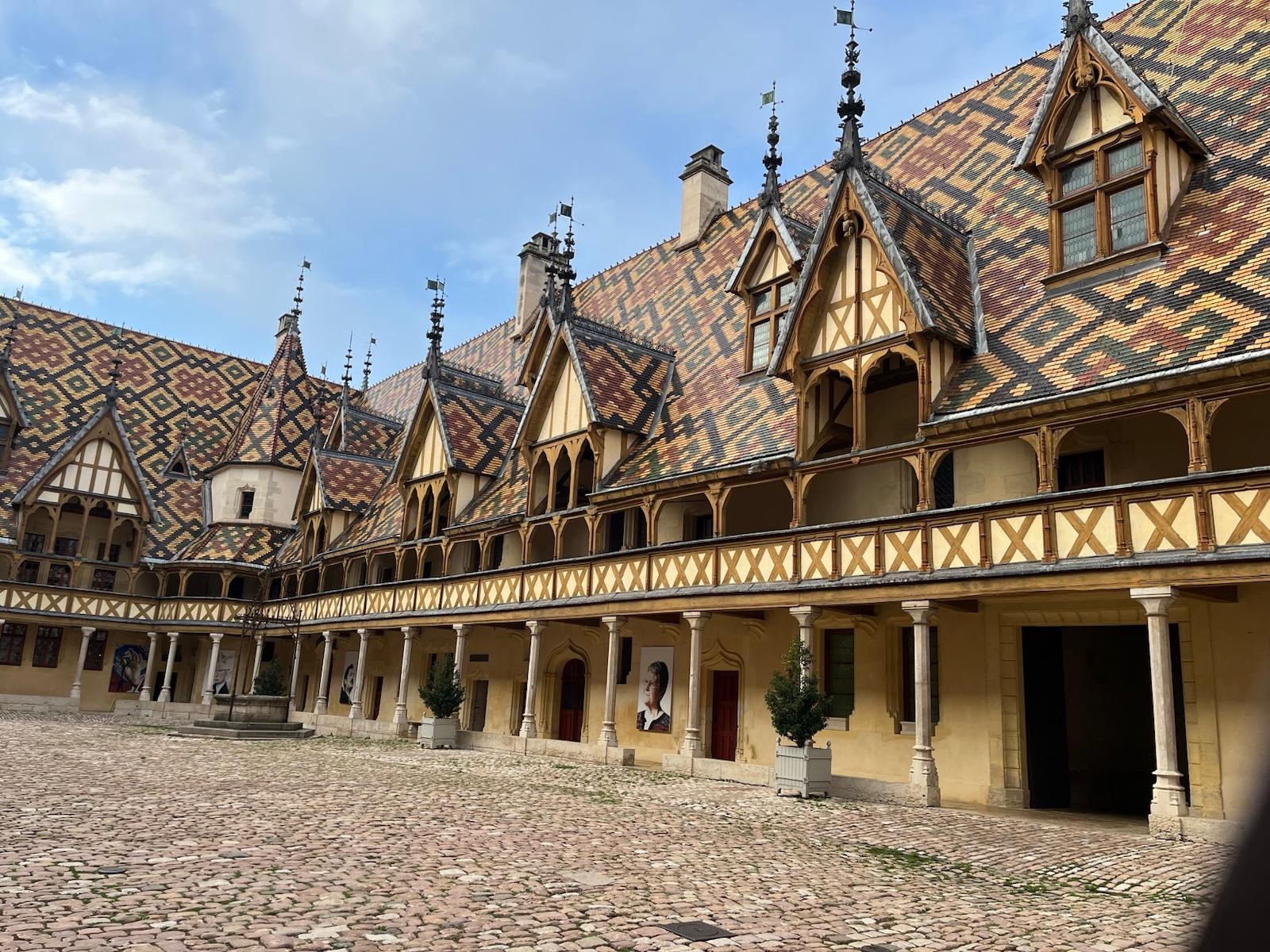
A cobbled courtyard surrounded by historic buildings with colourful tiled roofs.
Travelling and discovering heritage
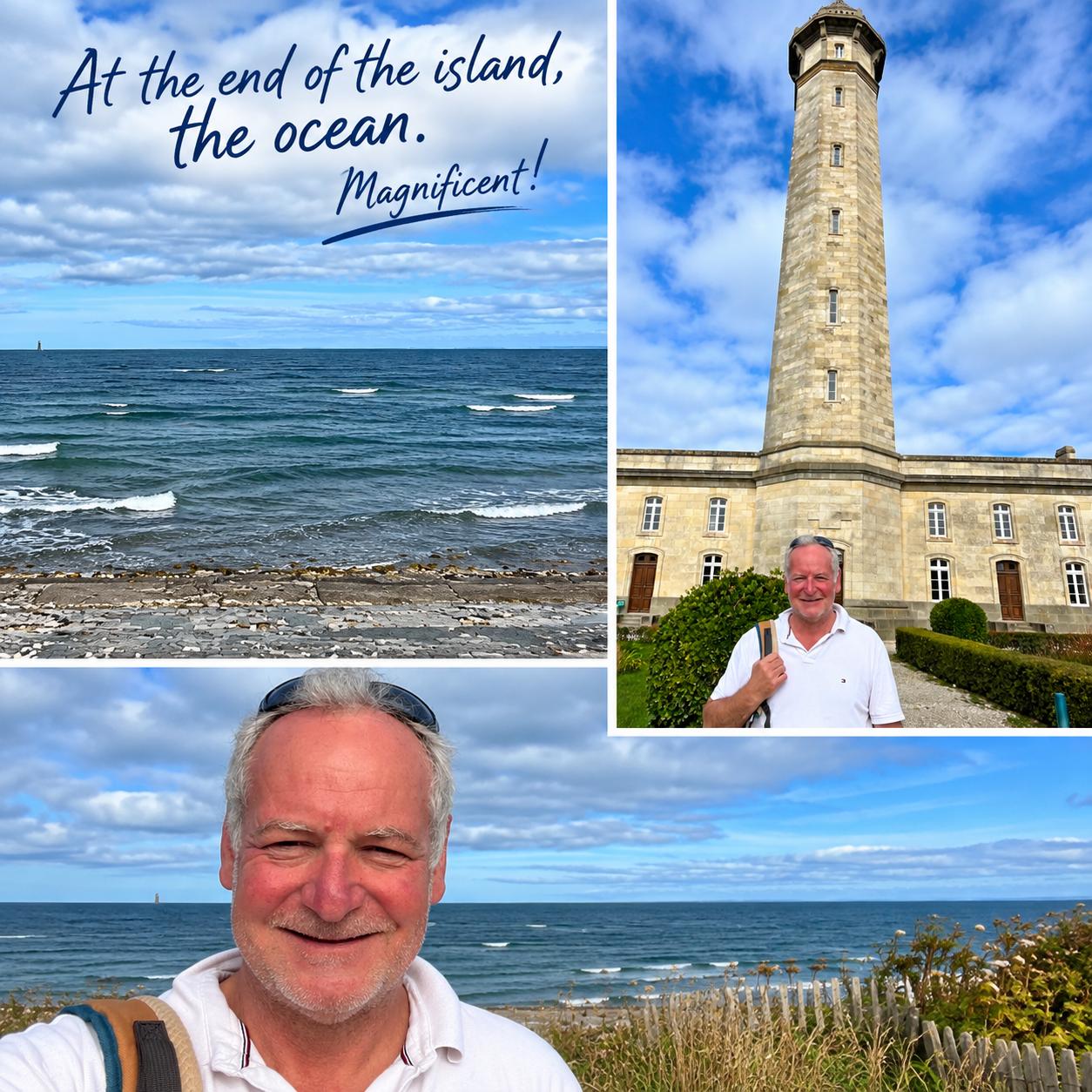
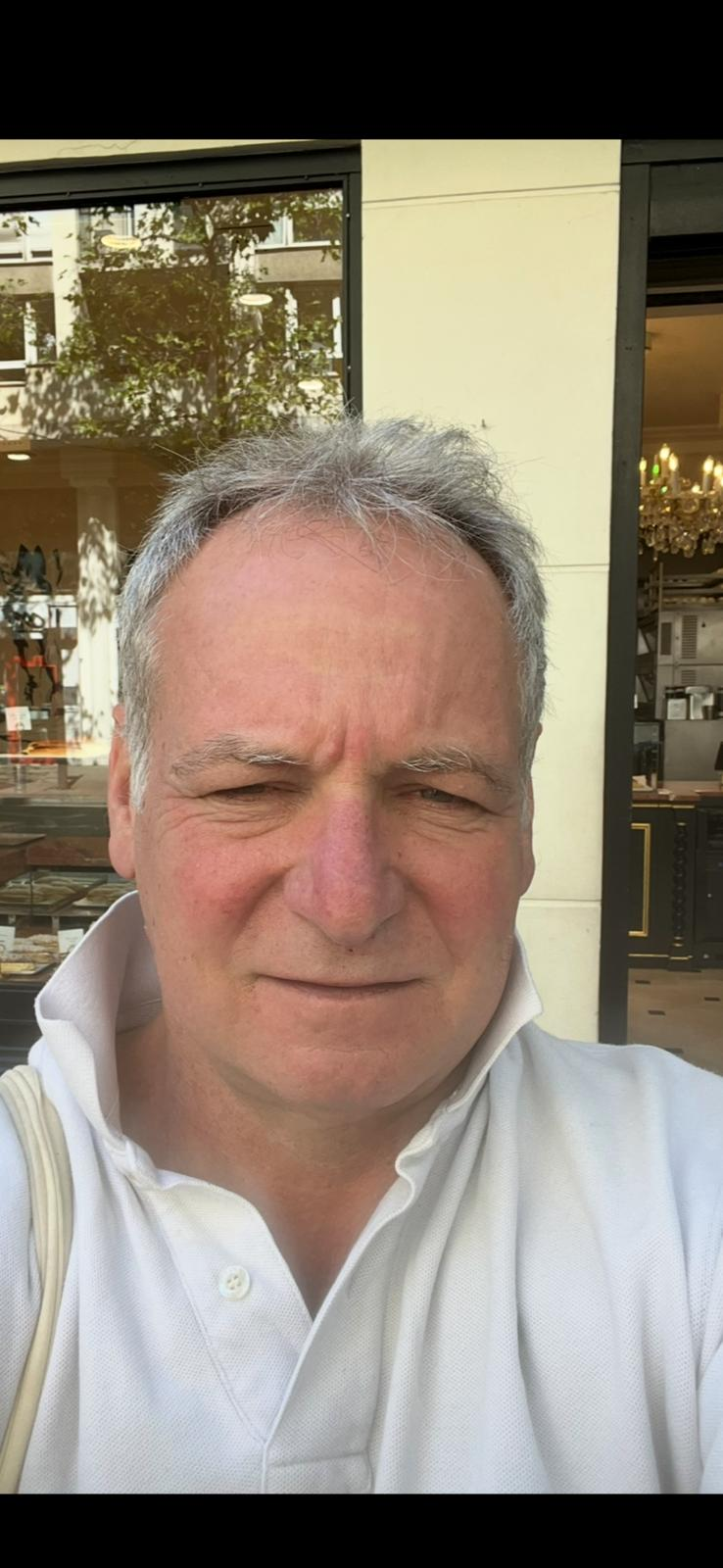
Christophe Scheller in a white polo shirt, outside a café.
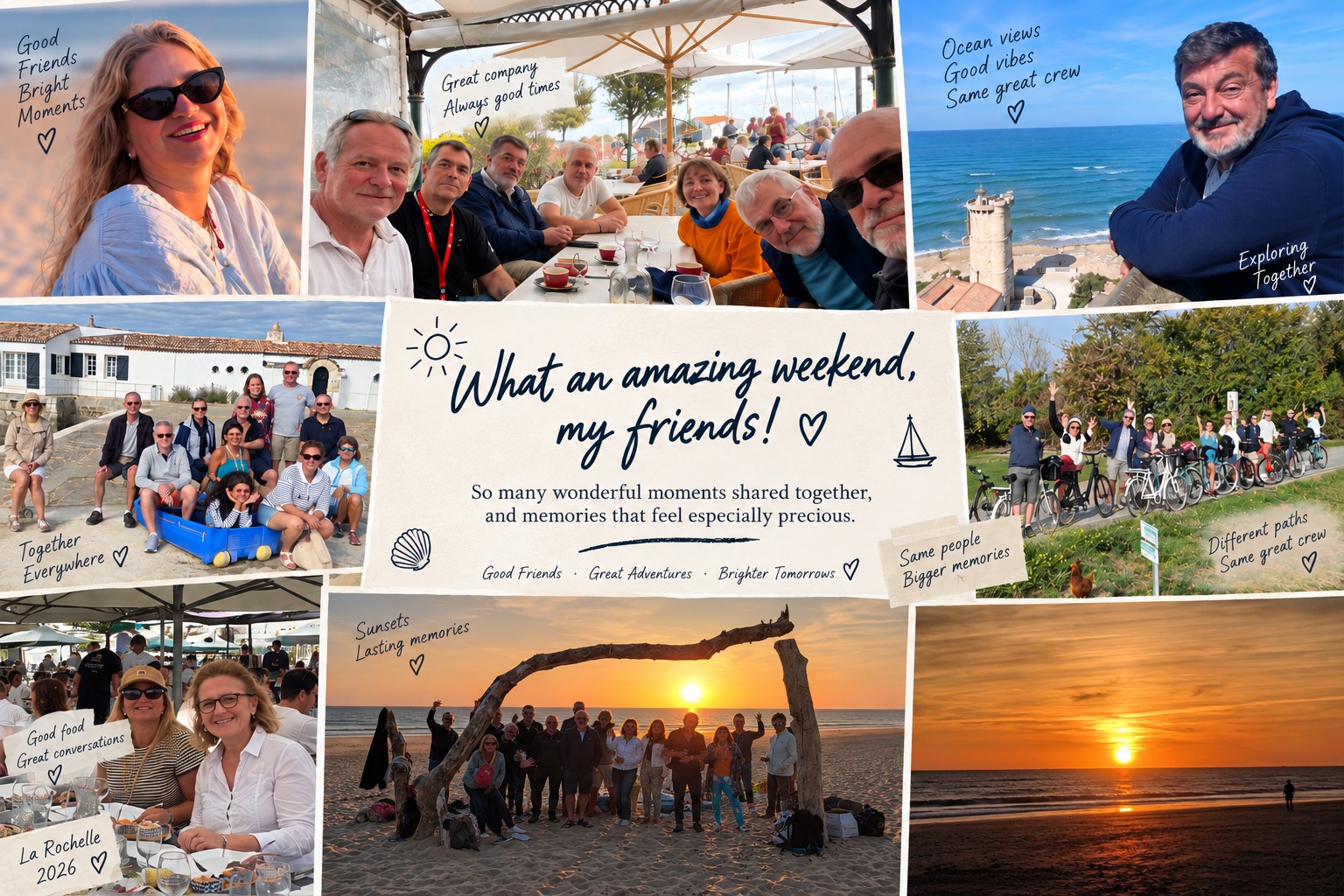
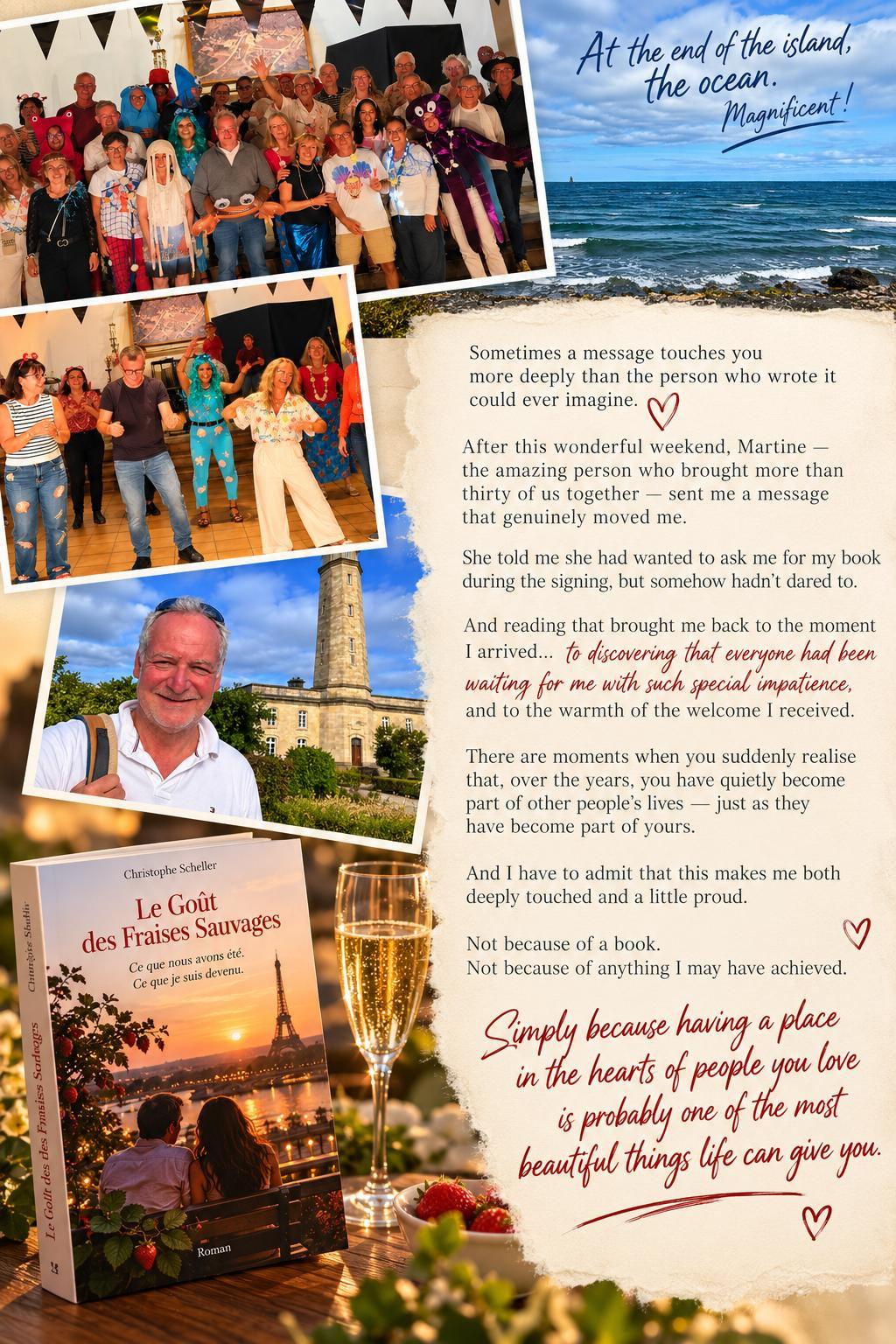
Memories of a weekend with friends: celebrations, the ocean and the book, alongside a message about friendship.
Friends, the ocean and the joy of sharing

What I’m listening to at the moment

A few songs keeping me company these days.

Spotify banner for the Le Goût des Fraises Sauvages playlist.
Listen to my selection on Spotify

Turn on shuffle in Spotify to hear the tracks in a different order.

A little squash

A little glimpse of my squash training: the pleasure of playing, being active and catching up with friends who share the same passion.

The encounter and its traces

The encounter in watercolours

The encounter in watercolours

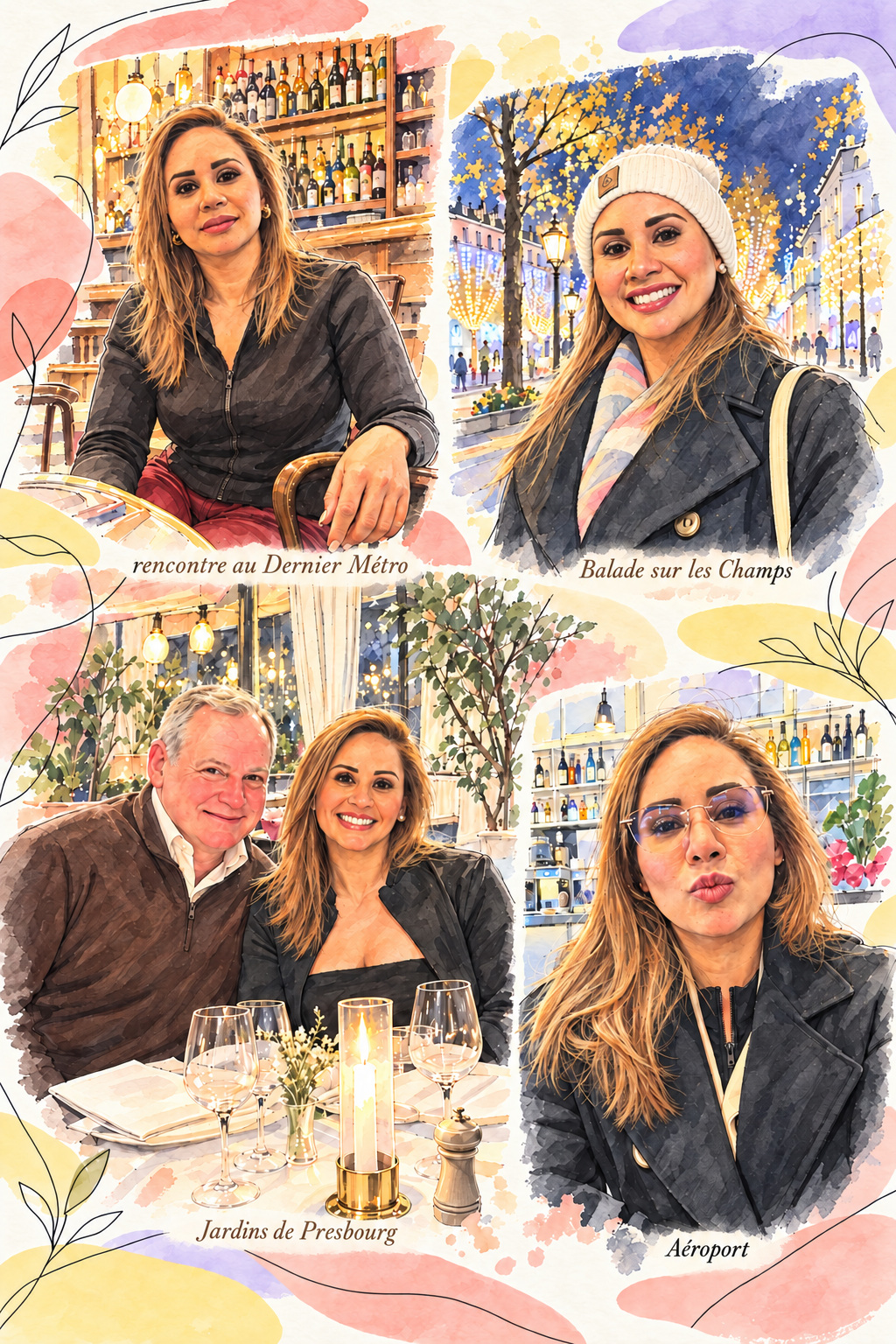
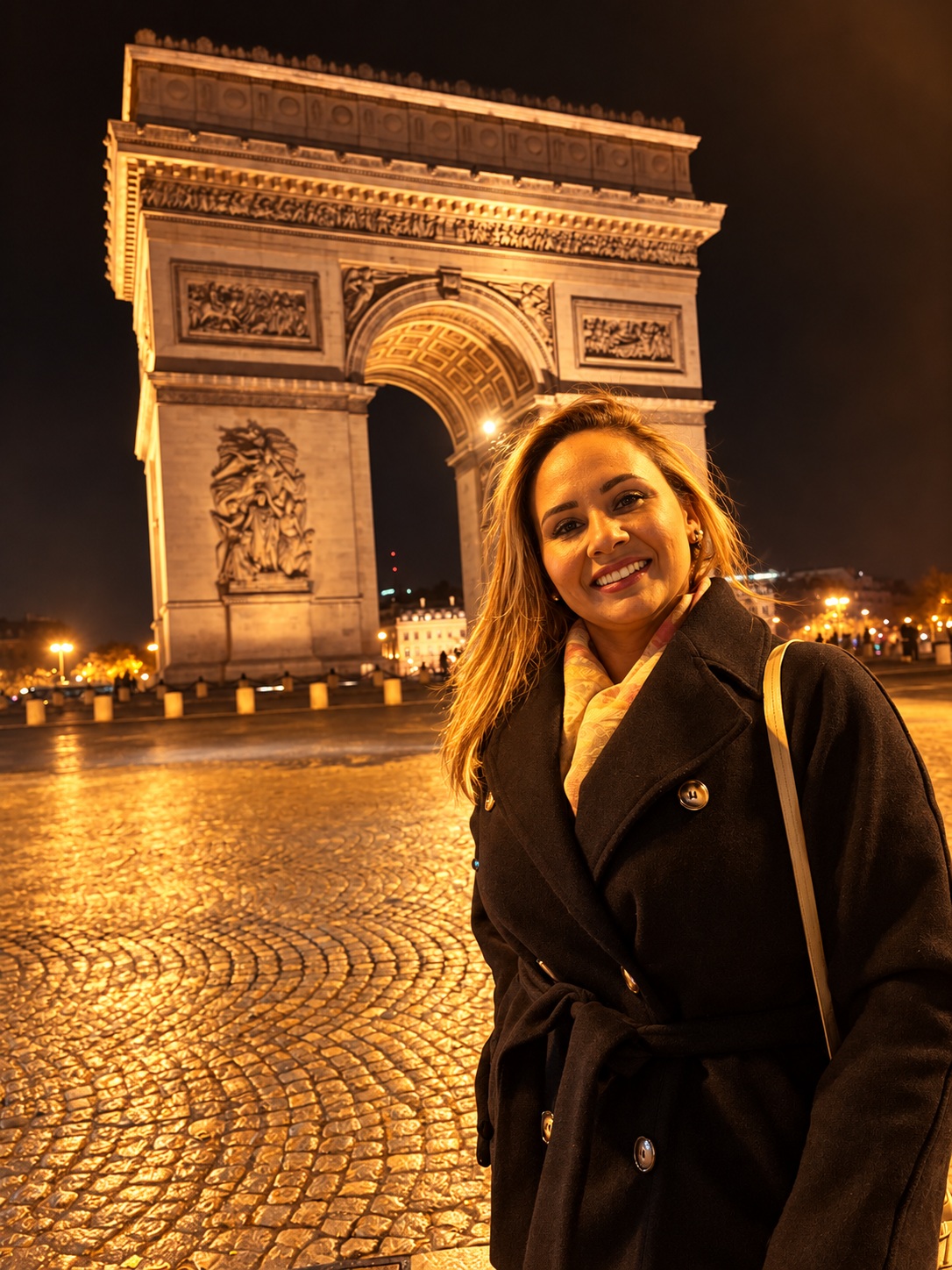
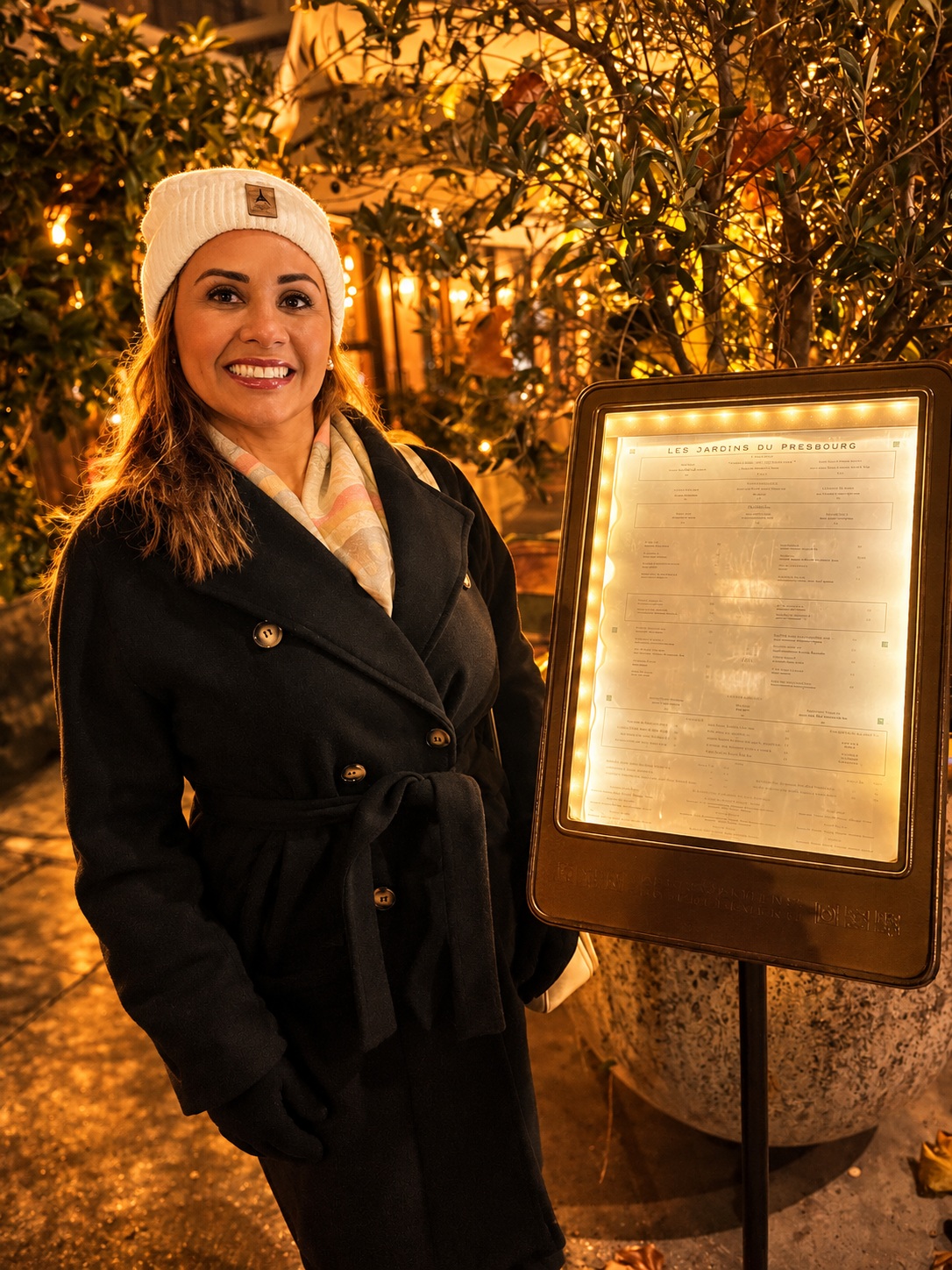
A few Parisian moments, reimagined in watercolours, echoing the opening pages of the novel.

Four memories in watercolours: meeting at Le Dernier Métro, a stroll along the Champs-Élysées, Les Jardins de Presbourg and the airport.

To Juliana

The encounter mattered. It did not need to last to have been real, nor to be fully explained to find a place in his life.

Excerpt from the novel’s synopsis
A portrait of Juliana

A birthday thought

The birthday card
The birthday card
A birthday wish
A birthday wish

The cards are shown in their original English version. The message is also reproduced below.

27… Funny how one number can become unforgettable.

Our paths have separated, but each has taken its own beautiful direction. And through it all, a very special affection has remained.

I wish you a truly wonderful birthday, surrounded by the people you love, filled with happiness and beautiful moments… and, of course, with a beautiful birthday cake!

Happy Birthday!

Readers

Writing is a solitary experience. Then comes the moment when a book leaves its author and meets its readers.

Some messages I received after readers finished Goût des Fraises Sauvages particularly moved me. They show that behind Christophe and Juliana’s story, each of us may sometimes find something of our own.

Reviews on Amazon

Six readers’ perspectives on the novel. Translated from the original French reviews.

Sabine Vasseur

A very beautiful piece of writing

A moving, respectful, intelligent story that I will probably remember for a long time. Bravo.

choco92lat

An honest and thoughtful reflection

This is not a book to judge, because no one would think of judging a heartfelt confidence. At first, we follow it with curiosity, until it leads us to a reflection that many of us undoubtedly share on our own limitations and the often painful circumstances in which they reveal themselves. A long time ago, a girl I loved told me that the trains we had not taken were the ones we had not wanted to take. In a way, this book teaches us that this is not entirely true: we simply could not take them.

Marie-Bénédicte LAMBERDIERE

A new author to discover

Beyond a love story as unusual as it is unexpected, the author takes us on a geographical and personal journey. His path and his search for answers cannot fail to move us and may also prompt deep questions within us...

This book is a pleasure to read, with fluid and precise writing.

One to pack in your suitcase for the summer!

Thierry WEISS

Feelings...

I appreciated the distinctive style of this introspective story, which explores feelings between dreams of the future, an understanding of the past and the reality of the present, which alone is lived...

rvstgo

A dive into the heart of feelings

An intense and captivating adventure, remarkably well written, filled with feelings that lift the soul, where tolerance is ever-present and commands respect. An absolute must-read.

Muriel YVENAT SCHELLER

A must-read ...

So much of it resonates with us....

Read the reviews on Amazon ↗

Feedback on Facebook

Reactions to the book’s announcement and reading impressions shared on Facebook. Translated from French.

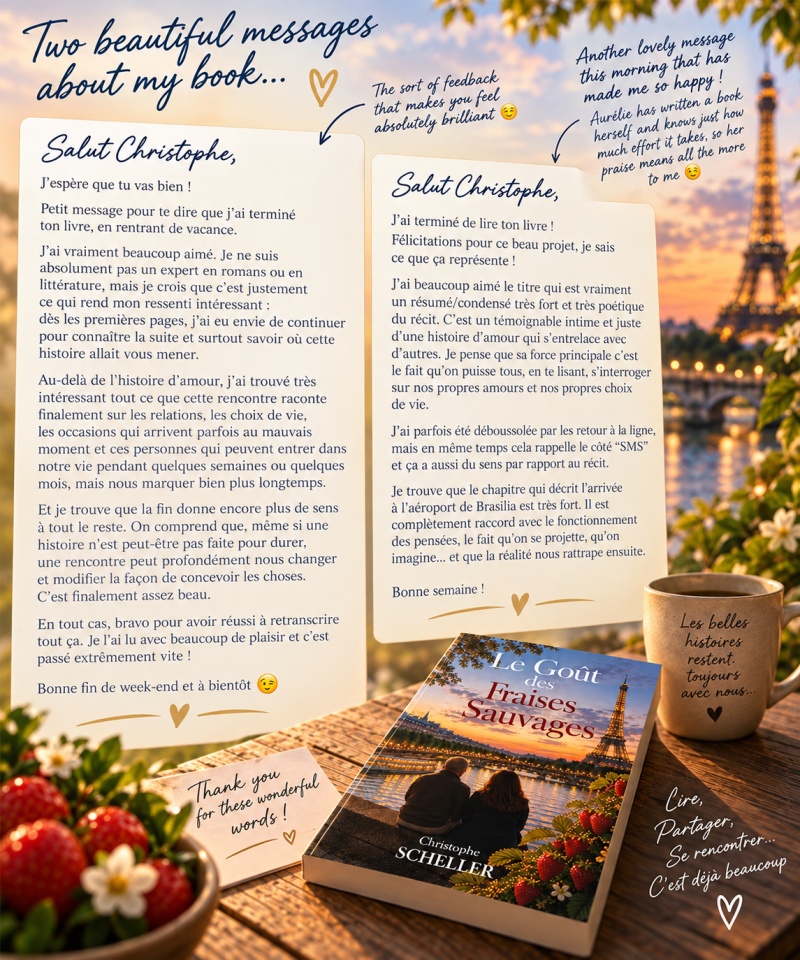
Feedback from my professional circle

Reader messages about Le Goût des Fraises Sauvages

My father’s response

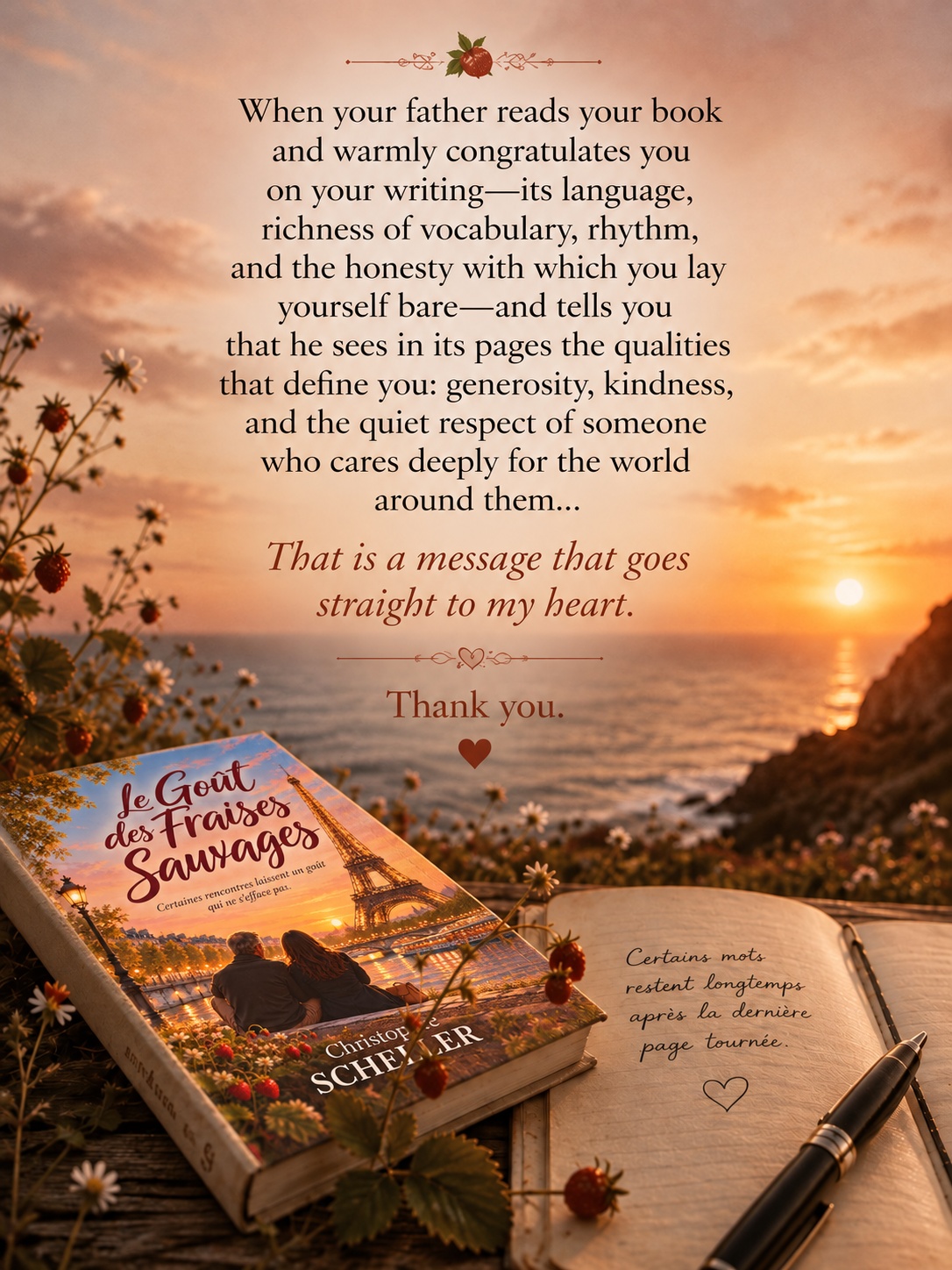
When my father reads my book and congratulates me on its language, richness of vocabulary, rhythm and honesty, his words go straight to my heart. He also sees in its pages qualities that, in his eyes, define me: generosity, kindness and a deep care for the world.

A particularly touching message from my father, illustrated by the book beside the ocean at sunset.

My mother’s response

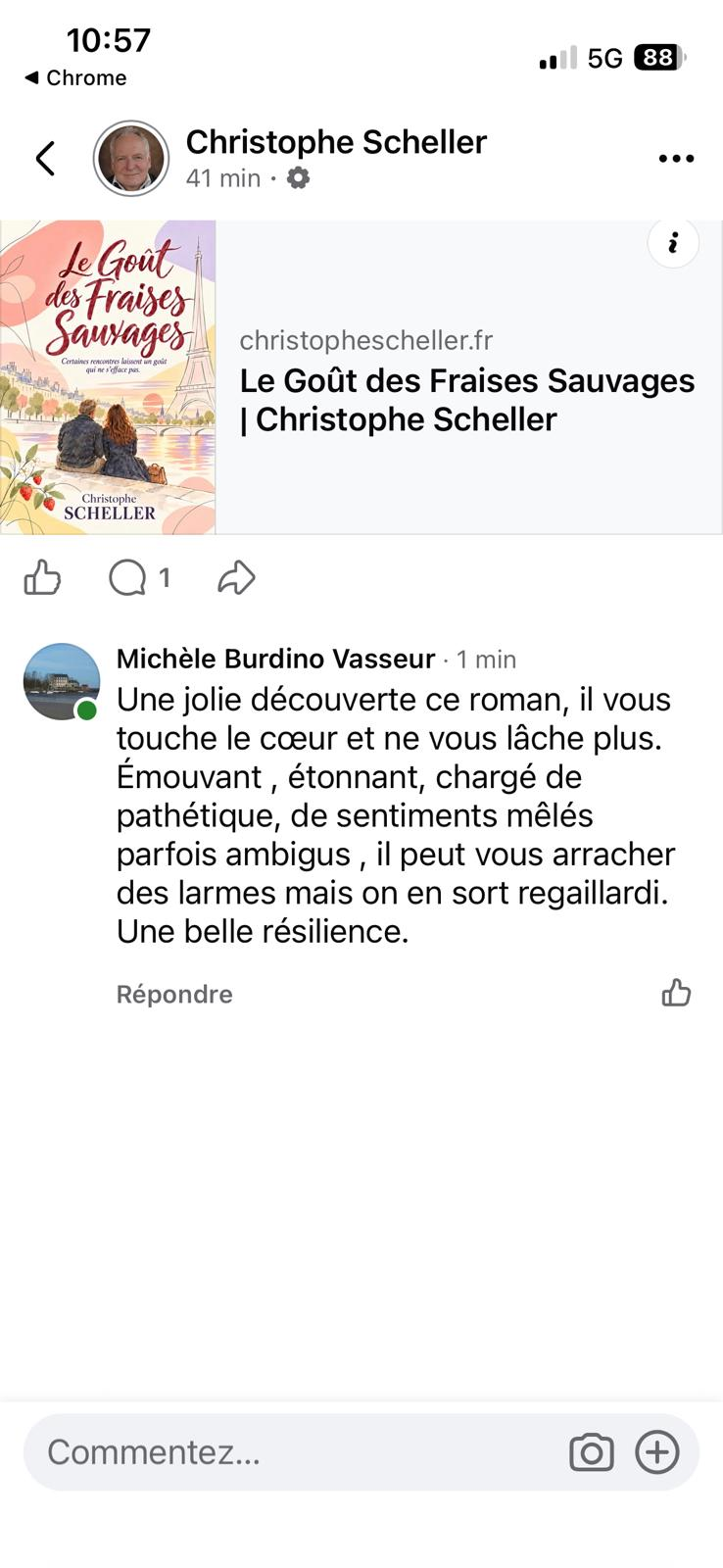
First comment

This novel is a lovely discovery: it touches your heart and never lets you go.

Moving, surprising, full of pathos and mixed, sometimes ambiguous feelings, it can bring tears to your eyes, yet you emerge uplifted.

A beautiful expression of resilience.

Michèle Burdino VasseurComments posted on Facebook

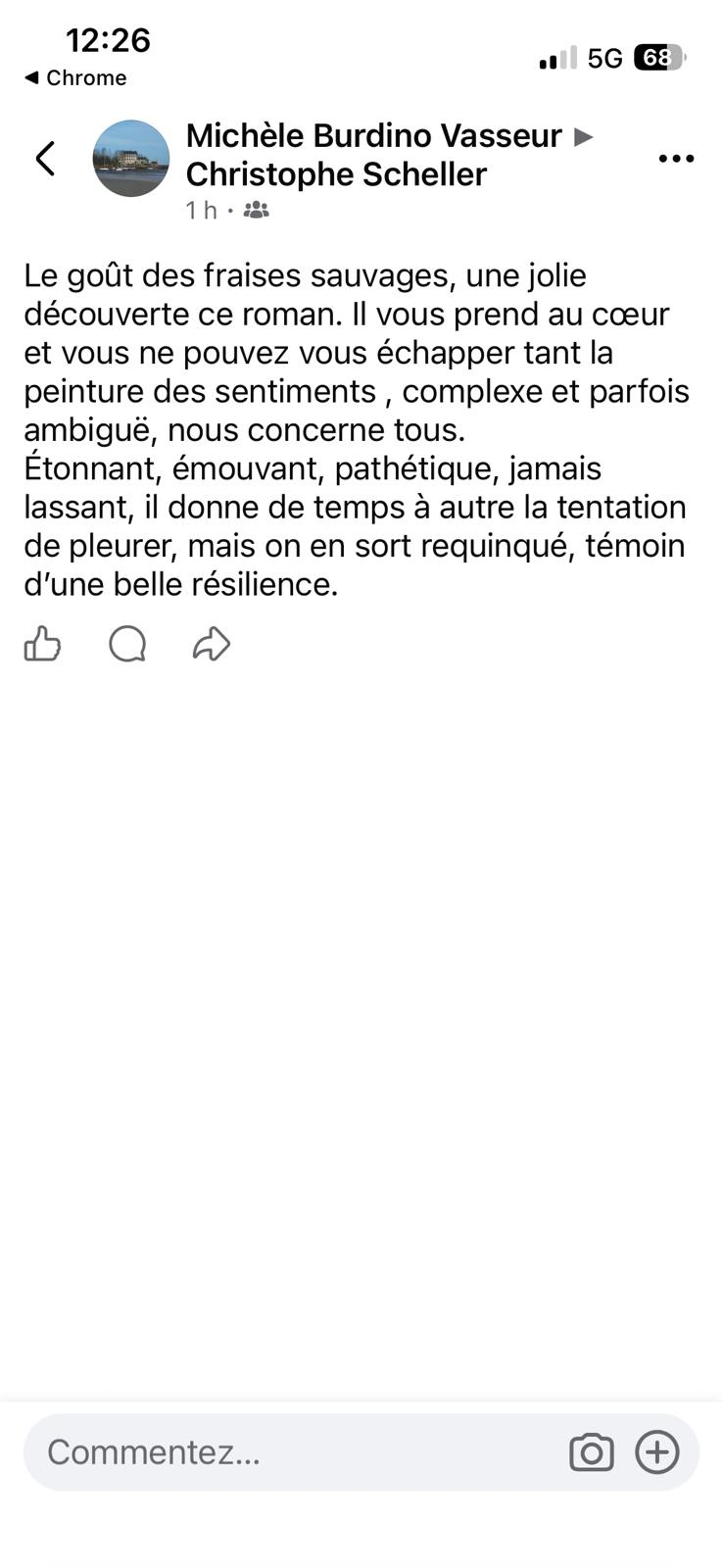
Second comment

The Taste of Wild Strawberries — this novel is a lovely discovery. It grips your heart, and you cannot escape it, so deeply does its portrayal of feelings, complex and sometimes ambiguous, speak to us all.

Surprising, moving, full of pathos and never tiresome, it sometimes makes you want to cry, yet you emerge refreshed, having witnessed a beautiful resilience.

Michèle Burdino VasseurComments posted on Facebook

Thank you to everyone who takes the time to tell me what this story has awakened in them.

LE GOÛT DES FRAISES SAUVAGES

What we once were.
What we are becoming.

Discover the book on Amazon